
II. Epidemiology
- Bimodal peaks for Plaque Psoriasis
- Young adulthood (ages 16 to 22 years old)
- Older age (late 50s)
- Prevalence: 1-3% of general population (U.S.)
- Men and women affected equally
III. Pathophysiology
- Underlying genetic predisposition is common
- Pathogenesis is likely a combination between genetic predisposition and exposure to inciting triggers
- Of those with Psoriasis, 30% also have a first degree relative with Psoriasis
- Children have a 50% chance of Psoriasis if both parents have Psoriasis (16% if only one parent has Psoriasis)
- Diabetes Mellitus Type 2 genetic predisposition also have higher Psoriasis risk (shared genetic loci)
- Autoimmune
- Viral Infection may precipitate process
- T-Cell-mediated autoimmune response
- Cytokines released and stimulate Keratinocytes
-
Keratinocytes proliferate
- Epidermal cells proliferate too fast
- Cells cycle in 4 days instead of normal 3-4 weeks
- Abnormal keratin production
- Dermal inflammation
- Epidermal cells proliferate too fast
IV. Risk Factors: Environmental Factors
- Suppressed by:
- Sun and humidity
- Provocative
- Injury to skin (e.g. Tattoo)
- Koebner Reaction with Plaque formation within 10 to 20 days of Skin Injury
- Lifestyle
- Emotional upset
- Tobacco Use
- Obesity
- Glucose Intolerance or Metabolic Syndrome
- Alcohol Abuse
- Infections
- Streptococcal Pharyngitis
- HIV Infection (severe exacerbations)
- Medications
- ACE Inhibitors
- Antimalarials
- Beta Blockers (e.g. Propranolol)
- Lithium
- NSAIDS
- Injury to skin (e.g. Tattoo)
V. Symptoms
-
Pruritus is present in >80% of psorisis
- Psora is greek for itching
VI. Signs: Chronic Plaque Psoriasis (90% of adult cases)
- Description
- Widespread
- Sharply demarcated
- Bright pink, red or salmon-colored Plaques
- Violet, red or blue coloration on darker skin
- Overlying loose, white to silvery scale
- Location: Symmetrical
- Over joints and extensor surfaces of extremities
- On trunk, especially lower back and buttocks
- Palms and soles
- Scalp
- Umbilicus
- Signs suggestive of Psoriasis
VII. Signs: Psoriatic Variants (Less Common)
- Guttate Psoriasis (drop-like)
- Uncommon, accounting for only 2% of Psoriasis cases
- Typically affects younger patients, under age 30 years, and especially school age children
- Trunk lesions are 1-10 mm Papules with fine scale
- Commonly occurs following Streptococcal Pharyngitis or Upper Respiratory Infection, esp. in children
- When associated with Streptococcal Pharyngitis, 60% will have complete remission within months
- When not associated with Streptococcal Pharyngitis, risk of progression to plaque Psoriasis
- Inverse Psoriasis (flexural)
- Well demarcated erythematous lesions with minimal scale affecting the skin folds
- Less scale present than in Plaque form
- Affects flexor surfaces (inframammary, axillary and inguinal folds)
- Affects perineal and intergluteal regions
-
Palmoplantar Pustulosis (Pustular Psoriasis)
- Likely represents a distinct condition from Psoriasis
- Multiple pin-sized, sterile Pustules on red base on the palms and soles without Plaques
- Most commonly triggered by medications that have been recently started (86% of cases)
- Acute Generalized Exanthematous Pustulosis (von Zumbusch) variant
- Severe, acute, life-threatening sub-type develops in <2 weeks
- Biopsy intact Pustule to exclude
- Erythrodermic Psoriasis (Erythroderma)
- Broad-spread generalized erythema and Desquamation involving >75% of body surface area (BSA)
- Systemic symptoms are typically present (see below)
- Acute, Type 2 form may be life threatening (in contrast to the chronic, Type 1 form)
VIII. Signs: Associated Findings
- Nail Psoriasis (Psoriatic Onychodystrophy)
- Lifetime Prevalence in up to 90% of Psoriasis patients (esp. Fingernails)
- Associated with higher risk of Psoriatic Arthritis
- Findings secondary to abnormal nail plate growth
- Nail Pitting
- Subungual hyperkeratosis
- Onycholysis
- Separation of distal edge of nail from nail bed
- Accumulation of crumbly subungual debris
- Other location specific signs
- Gluteal cleft
- Eroded pinkness in crease
- Penis (genital involvement in 40% of cases)
- Large joints
- Hyperkeratosis over elbows, knees, and ankles
- Tongue
- Geographic Tongue (rare)
- Gluteal cleft
- Systemic Signs
- Psoriatic Arthritis
- Uveitis (up to 20% of Psoriatic Arthritis cases)
- Severe widespread Psoriasis systemic signs
- Benign Lymphadenopathy
- Fever, chills, and Hyperthermia
- Increased cardiac demand
- High output Heart Failure
- Increased Sedimentation Rate and Uric Acid
- Decreased Serum Albumin
- Iron Deficiency Anemia
IX. Grading: Severity
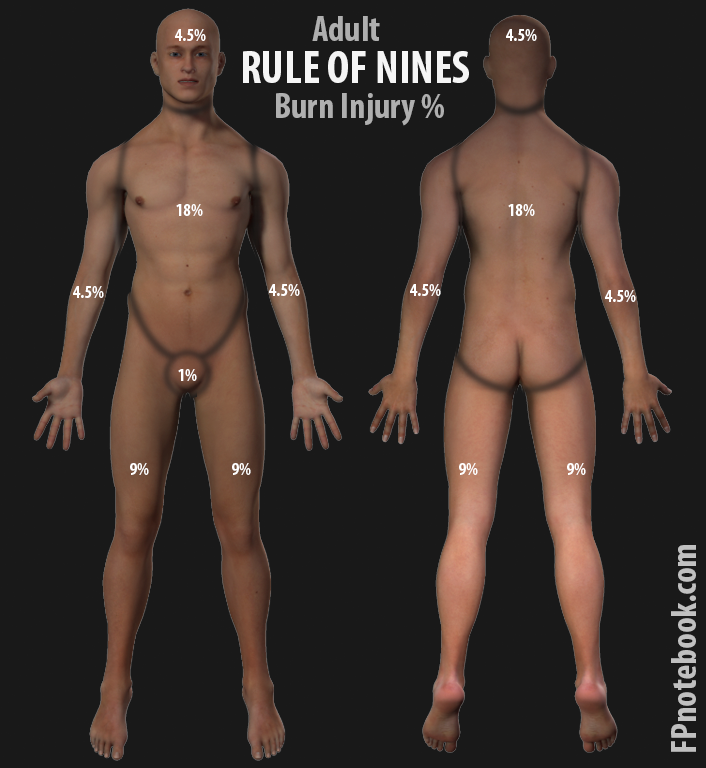
- Involved Body Surface Area (BSA)
- Mild: <3% BSA
- Moderate: 3 to 10% BSA
- Severe: >10% BSA
- Psoriasis Area and Severity Index (PASI)
- https://www.mdcalc.com/calc/10182/psoriasis-area-severity-index-pasi
- Mild: PASI<5
- Moderate: PASI 5 to 10
- Severe: PASI>10
- Life Quality Indexes (LQI)
- Children's Dermatology Life Quality Index (CDLQI)
- Dermatology Life Quality Index (DLQI)
- Mild: LQI <5
- Moderate: LQI 5 to 10
- Severe: LQI >10
X. Differential Diagnosis
- Plaque Psoriasis
- Lichen Simplex Chronicus
- Nummular Eczema
- Eczema lacks overlying scale and typically affects the flexor surface
- Seborrheic Dermatitis
- Tinea Corporis
- Ring-like lesion with central clearing
- Cutaneous Squamous Cell Carcinoma
- Sun exposed areas
- Group A Beta Hemolytic Streptococcus
- May present as Guttate Psoriasis in children
- Obtain ASO Titer and Throat Culture
- Guttate Psoriasis
- Pityriasis Rosea
- Smaller lesions that follow skin Cleavage Lines, and develop after viral illness
- Secondary Syphilis
- Erythematous Papules also involve palms and soles (spared in Psoriasis)
- Pityriasis Rosea
- Erythrodermic Psoriasis (Erythroderma)
- Atopic Dermatitis
- Fixed Drug Eruption
- Toxic Epidermal Necrolysis
- Cutaneous Sarcoidosis
- Pityriasis rubra pilaris
- Palmoplantar Pustulosis (Pustular Psoriasis)
- Inverse Psoriasis (flexural)
- See Intertrigo
- Nail Psoriasis (Psoriatic Onychodystrophy)
XI. Associated Conditions (some related to psoriatic medications)
-
Psoriatic Arthritis
- Affects 30% of adult plaque Psoriasis patients
- Children develop Psoriatic Arthritis in ~1% of Psoriasis cases
- Median onset 10 to 11 years after skin lesion onset in adults
- Up to 20% may have Psoriatic Arthritis findings that precede skin lesions
- Affects 30% of adult plaque Psoriasis patients
-
Inflammatory Bowel Disease (Crohns' Disease or Ulcerative Colitis)
- Risk increased 3.8 to 7.5x
- Celiac Disease (in 4-14% of Psoriasis patients)
- Malignancy
- Colorectal Cancer
- Squamous Cell Skin Cancer
- Risk increased 14x associated with PUVA in caucasians
- Lymphoma
- Risk increased 1.3 to 3x
-
Major Depression
- Prevalence: 60% of Psoriasis patients
- Also associated with Anxiety Disorder and Suicidality
- Other associated conditions with increased risk
XII. Management: General Measures
- Skin Emollients
- Soak lesions to ease adherent scale removal
- Apply Lac-Hydrin or salicylic acid applied daily to Plaques (reduces Scaling and softens Plaques)
- Apply skin Emollients (e.g. vaseline, aquaphor)
- Apply after soaks
- Apply 20 minutes after Corticosteroid application to boost steroid effect (similar to Occlusion)
- Consider Emollient only periods of steroid holiday
- Other lifestyle measures
- Maintain Ideal Body Weight
- Avoid Tobacco
- Limit Alcohol
- Stress Reduction
- Dermatology Referral Indications
- Psoriasis not responsive to topical agents
- Psoriasis diagnosis unclear
- Severe Psoriasis
- Refractory Guttate Psoriasis (requiring UVB Therapy)
- Moderate to severe nail Psoriasis requiring systemic therapy
- Other specialty referral indications
- Psoriatic Arthritis (Rheumatology)
- Inflammatory Bowel Disease (Gastroenterology)
XIII. Management: Approach - Mild Chronic Plaque Psoriasis
- See General Measures above
- Indications: Mild Chronic Plaque Psoriasis
- Involved Body Surface Area (BSA) <3%
- Psoriasis Area and Severity Index (PASI) <5
- Life Quality Index (LQI) <5
- Intermittent Flares
- Low potency Topical Steroids: Thin Skin (Skin folds, face, genitalia)
- High potency Topical Steroids: Thick Skin (Palms, soles, scalp, nails)
- Maintenance (Corticosteroid sparing agents)
- Vitamin D based topicals (Calcipotriene, Calcitriol)
- Calcineurin Inhibitor (Tacrolimus, Pimecrolimus)
- Topical Retinoids (Tazarotene)
XIV. Management: Approach - Moderate Chronic Plaque Psoriasis
- Indications: Moderate Chronic Plaque Psoriasis
- Involved Body Surface Area (BSA) 3 to 10%
- Psoriasis Area and Severity Index (PASI) 5 to 10
- Life Quality Index (LQI) 5 to 10
- Trunk and extensor surface involvement
- Initial and exacerbation therapy (<4 weeks only)
- Protocol 1: Topical Steroid and Calcipotriene
- High potency Topical Corticosteroid qAM and Calcipotriene qPM or
- High potency Topical Corticosteroid and Calcipotriene mixed 1:1 and applied daily or
- High potency Topical Corticosteroid daily weekends and Calcipotriene daily weekdays
- Protocol 2: Single agent
- High potency Topical Corticosteroid or
- Calcipotriene or
- Tazorotene (Tazorac)
- Protocol 1: Topical Steroid and Calcipotriene
- Long-term maintenance (beyond 4 weeks)
- Calcipotriene or
- Tazorotene (Tazorac)
- Initial and exacerbation therapy (<4 weeks only)
- Flexor surface involvement
- Moderate Topical Corticosteroids (<4 weeks) OR
- Calcineurin Inhibitor (Tacrolimus or Pimecrolimus)
- Scalp involvement
- Exacerbations
- Calcipotriene/Betamethasone Dipropionate gel for 4 to 12 weeks (8 weeks in age 12 to 18 years) OR
- Calcipotriene foam for 4 to 12 weeks OR
- Clobetasol 0.05% Shampoo used briefly
- Maintenance
- Exacerbations
- Nail Involvement
- Exacerbations with 1-2 nails involved
- Adjuncts
- Lac-Hydrin or salicylic acid applied daily to soften Plaques
XV. Management: Approach - Severe Chronic Plaque Psoriasis
- Indications
- Severe Chronic Plaque Psoriasis
- Involved Body Surface Area (BSA) >10%
- Psoriasis Area and Severity Index (PASI) >10
- Life Quality Index (LQI) >10
- Psoriasis refractory to topical and UVB therapy
- Comorbid Psoriatic Arthritis
- Involvement of hands, feet, face or genitalia
- Severe Chronic Plaque Psoriasis
- Protocol usually managed by dermatology
- Use above topical agents
- See UVB Therapy as below
- Most effective Biologic Agents in severe Chronic Plaque Psoriasis
- See Systemic Agents below (non-biologics and biologics)
- Infliximab
- Bimekizumab
- Ixekizumab
- Sbidian (2023) Cochrane Dabatase Syst Rev (7): CD011535 [PubMed]
XVI. Managament: Approach - Children and Teens
- Presentations
- Plaque Psoriasis
- Typical onset in teens
- Guttate Psoriasis
- Onset in younger children, and frequently associated with Streptococcal Pharyngitis
- Spontaneous remission within months for 60% whose onset was associated with Strep Throat
- Psoriatic Arthritis
- Complicates only 1% of childhood Psoriasis (contrast with 30% comorbid Psoriatic Arthritis in adults)
- Younger children present with Oligoarthritis and Dactylitis
- Oldern children and teens present with enthesitis and axial joint involvement
- Complications (associated with Bullying, esp. teens)
- Plaque Psoriasis
- First-line agents
- Skin Emollients and keratin-softening agents (See general measures as above)
- Topical Corticosteroids (any age)
- Daily use in flares for up to 14 days
- Avoid high potency Corticosteroids (if possible) in age <6 years
- Calcipotriene (age >12 years)
- Use with or without Corticosteroids for up to 4 weeks
- See Vitamin D Analog Topicals below for precautions (esp. Hypercalcemia risk)
- Narrowband UVB Phototherapy
- Indicated in children with involved BSA 10 to 25%
- Consider in combination with coal tar pretreatment for 12 days
- Second-Line Agents in refractory, moderate to severe cases
- Methotrexate
- Biologics
- Etanercept (age >=4 years)
- Ustekinumab (age >= 6 years)
- Ixekizumab (age >= 6 years)
- Secukinumab (age >= 6 years)
XVII. Management: Approach - Pregnancy
- Most Psoriasis improves during pregnancy and worsens postpartum
- However, variable across pregnancies (and can worsen in up to a third of pregnancies)
- Topicals should not be applied near the nipple in lactating mothers (avoid infant ingesting medication)
- First-line
- Topical Skin Lubricants
- Low to moderate potency Topical Corticosteroids (<60 g/week in pregnancy)
- UVB Phototherapy
- UVB decreases Serum Folate
- Maintain at least 0.8 mg Folate daily
- Severe cases (after first trimester)
- TNF Inhibitors
- Stop early in third trimester
- Avoid Live Vaccines in newborns for first 6 months
- Interleukin-12/23 Inhibitors (e.g. Ustekinumab)
- Likely safe in pregnancy and Lactation
- Interleukin-17 Inhibitors (e.g. Secukinumab, Ixekizumab)
- Likely safe in pregnancy and Lactation
- Systemic Corticosteroids
- Cyclosporine
- May increase risk of Low Birth Weight Infant, premature birth, maternal infection
- Avoid in Lactation
- TNF Inhibitors
- Contraindicated Agents in Pregnancy and Preconception
- Calcineurin Inhibitor (Tacrolimus, Pimecrolimus) if >1% BSA involved
- Retinoids (Acretretin, Tazarotene)
- Apremilast (based on animal studies)
- Men should also avoid for at least 2 days before conception
- Methotrexate
- Allow for at least 3 month washout before conception
- References
XVIII. Management: Topical Preparations
- Skin Emollients and keratin-softening agents
- See general measures as above for protocols including soaking
- First-line agents for daily use
- Skin Emollients (e.g. vaseline, aquaphor)
- Applied daily
- See Skin Lubricant
- Keratin-softening agents
- Applied daily to Plaques (reduces Scaling and softens Plaques)
- Apply before Topical Corticosteroids or Calcineurin Inhibitors
- Lac-Hydrin (Alpha-Hydroxy acid)
- Salicylic acid (2 to 6%, Keratolytic Agent)
- Applied once daily (twice daily for thick Plaques)
- In age <6 years, limit to 0.5% and only to small patches
- Decreases UVB Phototherapy efficacy
- Inactivates Vitamin D Analogs (Calcipotriene, Calcitriol)
- Applied daily to Plaques (reduces Scaling and softens Plaques)
-
Topical Corticosteroids
- High Potency Topical Steroids (Class 2 to 5, usually indicated for treatment, esp. on thicker skin)
- Dosing
- Very high potency: e.g. Clobetasol (Temovate)
- High potency: e.g. Fluocinonide (Lidex)
- Contraindications
- Thin skin (e.g. face, genitalia, Forearms)
- Avoid high potency Topical Corticosteroids in children age <6 years (if possible)
- Limit to 1 potent steroid applied up to twice daily for a maximum of 4 weeks (2 weeks in children)
- May extend to longer use on palms and soles
- Taper off potent steroids (over 2 weeks) to prevent rebound exacerbation
- Apply every other day for 1 week, then
- Apply twice weekly, then stop
- Maintenance
- Rotate to lower potency steroids or decrease application frequency (e.g. twice weekly)
- Consider Emollient only periods until reexacerbation
- Dosing
- Low to Medium Potency Topical Steroids (e.g. Hydrocortisone 2.5%)
- Face
- Genitalia
- Forearms
- Intertriginous regions
- Maintenance Therapy
- High Potency Topical Steroids (Class 2 to 5, usually indicated for treatment, esp. on thicker skin)
- Intralesional Corticosteroids
- Indications
- Mild to moderate psoriatic Plaque on thick skin (e.g. scalp, palms, soles) not responding to topical agents
- Dosing
- Triamcinolone Acetonide 2.5 to 20 mg/ml injected into lesion every 3-4 weeks
- Indications
-
Vitamin D Analog Topicals (Calcipotriene, Calcitriol)
- Indications
- Moderate Psoriasis involving 5-20% of body surface area
- Mild to moderate scalp Psoriasis (foam or gel for 4-12 weeks)
- Alternative to Corticosteroids for maintenance therapy of Psoriasis on thin skin
- Nail Psoriasis with 1-2 nails involved (Calcipotriene/Betamethasone Dipropionate with Tazarotene)
- Medications
- Calcipotriene (Dovonex)
- Creams or ointments are applied once to twice daily
- Also available as a foam, or a combination with Betamethasone gel for use on scalp
- Calcitriol (Vectical)
- May be less irritating than Calcipotriene (Dovonex)
- Calcipotriene (Dovonex)
- Combinations
- May be used in combination with Phototherapy
- Apply AFTER Sun Exposure or Phototherapy to prevent drug inactivation with UV exposure
- Typically used in combination with Topical Corticosteroids (esp. for acute exacerbation)
- Spares Corticosteroids and combination is more effective than either drug alone
- Apply as a 1:1 mixture with Corticosteroid
- Alternatively apply on different days (e.g. weekend steroids, weekday Vitamin D)
- Methotrexate
- May spare Methotrexate dosing
- May be used in combination with Phototherapy
- Adverse Effects: Risk of Hypercalcemia in high dose exposure and Renal Insufficiency
- Limit to 75 g/week for <30% BSA involved
- Limit to 50 g/week in children age 6 to 12 years
- Efficacy
- Benefits may be delayed 6 to 8 weeks
- Indications
-
Retinoids
- Acritretin (Soriatane, oral)
- Tazarotene (Tazorac, topical)
- Apply cream or gel every night to affected areas
- More irritating than Calcipotriene
- Contraindicated in pregnancy (Teratogenic)
- Efficacy
- As effective as Corticosteroids, but with longer disease-free periods
- Also effective in palmar-plantar Psoriasis and nail Psoriasis
- Consider in combination with Phototherapy
-
Calcineurin Inhibitor (Tacrolimus, Pimecrolimus)
- Indications
- Common alternative to Corticosteroids for maintenance therapy of Psoriasis on thin skin
- Less skin atrophy than with Corticosteroids
- Common alternative to Corticosteroids for maintenance therapy of Psoriasis on thin skin
- Agents
- Tacrolimus 0.1% cream
- Pimecrolimus 0.1% cream
- Dosing
- Efficacy
- Effective in facial and intertriginous Psoriasis
- Lebwohl (2004) J Am Acad Dermatol 51:723-30 [PubMed]
- Adverse effects
- Risk of Skin Cancer and Lymphoma (especially in combination with UV Light Therapy)
- Indications
- Novel newer agents (expensive and unclear efficacy in comparison with established agents)
- Aryl Hydrocarbon Receptor Agonists (AhR Agonists)
- Roflumilast (Vtama) 1% Cream applied once daily
- Approved only for adults
- Considered safe for longterm use, including in regions of thin skin (e.g. groin, face)
- Adverse effects include Folliculitis in up to 20% of patients
- Roflumilast (Vtama) 1% Cream applied once daily
- Phosphodiesterase 4 Inhibitors (PDE4 Inhibitors)
- References
- (2022) Presc Lett 29(10): 58-9
- Aryl Hydrocarbon Receptor Agonists (AhR Agonists)
- Poorly tolerated topicals (Calcipotriene has largely replaced these)
- Historically used with UVB light exposure
- Anthralin 0.1% (Anthra-Derm)
- As effective as Calcipotriene
- Adverse effects include perilesional erythema, skin staining, burning Sensation
- Avoid applying to face or other sensitive areas, and avoid applying for longer than 2 hours
- Coal Tar (e.g. Zetar)
- Effective and inexpensive
- Consider in patients who can not afford other options
- More effective than Calcipotriene
- Avoid in pregnancy and Lactation
- Adverse effects include Folliculitis, Contact Dermatitis, Phototoxic Dermatitis
XIX. Management: Narrowband Ultraviolet Light (UVB)
- Indications
- Plaque Psoriasis or Guttate Psoriasis 10 to 25% BSA involved, refractory to topical agents
- Adverse Effects
- Inconvenient (multiple visits per week)
- Non-melanoma Skin Cancer (esp. PUVA)
- Efficacy
- Cost-effective and decreases overall Topical Medication use
- Protocols
- Ultraviolet B exposure alone
- Ultraviolet B and 12 days of Coal Tar Pretreatment (children)
- Ultraviolet A exposure with psoralen (PUVA)
- Increased risk of non-melanoma Skin Cancer
XX. Management: Systemic Preparations
-
General
- Most agents are higher risk for systemic adverse effects and very expensive
- Indicated for moderate to severe Psoriasis
- Refractory to topical agents and UVB Therapy
- Involves >5% body surface area (BSA)
-
Immunosuppressants
- Methotrexate
- Typically trialed as a first-line systemic agent (unclear efficacy)
- Start with oral Methotrexate
- May consider Methotrexate SQ if inadequate oral effect, or significant gastrointestinal effects
- See Methotrexate for monitoring guidelines
- Folic Acid 1-5 mg daily (except for the day Methotrexate is taken)
- Reduces adverse effects (Mouth Sores, gastrointestinal effects)
- Indications to switch therapy to other systemic agent (or to add in combination with Methotrexate)
- Psoriasis Area and Severity Index Score fails to improve 25% after 4 weeks on Methotrexate
- Cyclosporine
- Used as a rescue agent for flares in refractory cases for up to 12 weeks
- Monitor Blood Pressure and Renal Function (see Cyclosporine for monitoring)
- Methotrexate
- Systemic Retinoids (oral)
- Acitretin (Soriatane)
- Slow onset over 3-6 months
- Most effective in combination with Phototherapy (and Corticosteroids, Calcipotriene)
- Similar adverse effects to Accutane
- Acitretin (Soriatane)
-
Phosphodiesterase Inhibitor (Type 4)
- Apremilast (Otezla)
- Does not require lab monitoring
- Indicated for mild to moderate Psoriasis (released in U.S., 2015)
- Adverse effects include Diarrhea, Nausea, Headache as well as weight loss and depression
- Avoid use with Strong Cytochrome P450-3A4 Inducers (e.g. Rifampin, Carbamazepine)
- Apremilast (Otezla)
-
Biologic Agents
- General
- Very expensive agents ($10k to >$20k/year)
- More effective than Methotrexate
- Insurance approval typically requires Methotrexate failure first
- Live Vaccines are contraindicated with on Biologic Agents
- Most effective agents in severe Chronic Plaque Psoriasis: Infliximab, Bimekizumab, Ixekizumab
- Tumor Necrosis Factor Inhibitor (Anti-TNF Agents)
- See TNF Inhibitor for precautions and complications
- Adalimumab (Humira)
- Preferred TNF agent
- Ustekinumab (Stelara)
- Preferred TNF agent
- Hold therapy during febrile illness
- Etanercept (Enbrel)
- Less effective than Adalimumab (Humira) and Ustekinumab (Stelara)
- Leonardi (2003) N Engl J Med 349:2014-22 [PubMed]
- Infliximab (Remicade)
- More adverse effects than other TNF agents
- Winterfield (2004) Dermatol Clin 22:437-47 [PubMed]
- Brodalumab (Siliq)
- Increased Suicide Risk
- Guselkumab (Tremfya)
- Other mechanisms
- Deucravacitinib (Sotyktu)
- Tyrosine Kinase 2 inhibitor
- More effective than Apremilast (Otezla), but expensive and unclear if it will demonstrate Cardiovascular Risks of JAK Inhibitors
- Cosentyx (secukinumab)
- Interleukin-17a blocker available in U.S. in 2015
- Dosed every 8 to 12 weeks
- Ustekinumab (Stelara)
- Interleukin-23 blocker
- Risk of worsening Inflammatory Bowel Disease
- Dosed every 2-4 weeks
- Deucravacitinib (Sotyktu)
- General
- Experimental
- Thiazolidinedione (Actos)
- Appears effective in Psoriasis even in non-diabetics
- Only small trials support to date
- Ellis (2000) Arch Dermatol 136(5):609-16 [PubMed]
- Malhotra (2012) Evid Based Med 17(6):171-6 +PMID: 22522793 [PubMed]
- Thiazolidinedione (Actos)
XXI. References
- (2022) Presc Lett 29(12): 71-2
- (2015) Presc Lett 22(3): 16
- Garner (2023) Am Fam Physician 108(6): 562-73 [PubMed]
- Hsu (2012) Arch Dermatol 148(1): 95-102 [PubMed]
- Luba (2006) Am Fam Physician 73:636-46 [PubMed]
- Mason (2002) Br J Dermatol 146:351-64 [PubMed]
- Mason (2013) Cochrane Database Syst Rev (3): CD005028 [PubMed]
- Menter (2008) J Am Acad Dermatol 58(5): 826-50 [PubMed]
- Teichman (2018) Am Fam Physician 97(2): 102-10 [PubMed]
- Weigle (2013) Am Fam Physician 87(9): 626-33 [PubMed]
- Elmets (2021) J Am Acad Dermatol 84(2):432-70 +PMID: 32738429 [PubMed]