
II. Epidemiology
- Most common Entrapment Neuropathy of the arm
- Incidence: 3% of U.S. general population
- Women outnumber men affected by 3 fold
- Bilateral in 50% of cases
- Associated with workplace repetitive hand activities
- Hand Paresthesias occur in 30% of computer users
- Only 10% of these meet criteria for Carpal Tunnel
- Only 3.5% of these have abnormal EMGs
- Stevens (2001) Neurology 56:1568-70 [PubMed]
III. Pathophysiology
- Compression of Median Nerve
- Occurs between transverse carpal ligament and underlying Carpal Bones
- Median Nerve adjacent to 9 inflamed and enlarged synovial lining of flexor tendons
- Sensory deficits predominate
- Motor Nerves are much less susceptible than Sensory Nerves to compression
IV. Risk Factors
- Repetitive motion of hand and wrist
- Most common cause, and typically work related
- More common if significant force applied or hand-operated vibratory tool
- Local wrist or Hand Trauma
- Obesity
- Many associated conditions (see below)
V. Associated Conditions
- Hypothyroidism
- Diabetes Mellitus
- Acromegaly
- Rheumatoid Arthritis
- Gouty Arthritis
- Lyme Disease
- Amyloidosis
- Multiple Myeloma
-
Edematous condition
- Third trimester of Pregnancy
- Symptoms subside after delivery
- Congestive Heart Failure
- Renal Failure
- Third trimester of Pregnancy
- Aberrant or Anomalous Muscles in wrist
- Proximal lumbrical insertion
- Distal extension of flexor superficialis Muscle
- Persistent thrombosed median artery
- Abnormal palmaris longus tendon
- Ganglion Cyst
- Lipoma
- Double-Crush Syndrome
VI. Symptoms
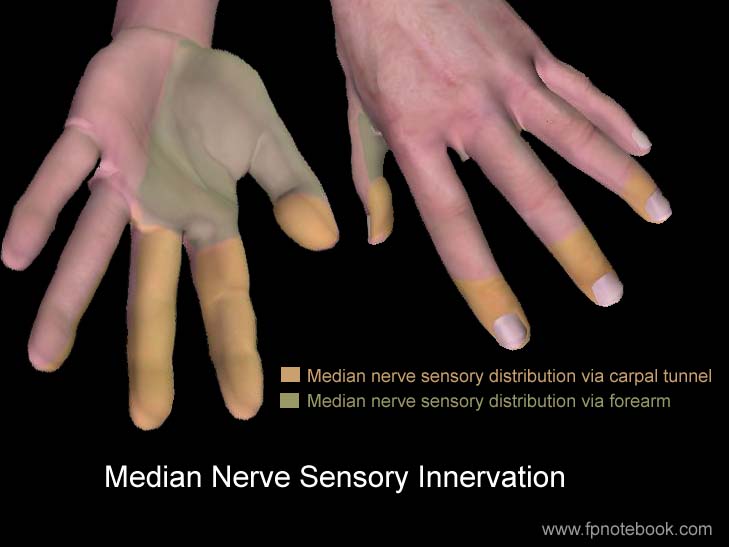
- Image: Median Nerve Sensory Innervation
-
Paresthesias along Median Nerve course (palmar surface)
- Electrical Sensation or Dysesthesias
- Commonly involves only palmar Index and Middle fingers
- May affect palmar aspect of all Median Nerve innervated 3.5 fingers (thumb to fourth finger)
- Pain in distal, palmar surface of wrist or arm
- Distal radiation into thumb, index and middle finger
- Radiation
- Proximal radiation into Forearm (may rarely radiate proximally into Shoulder and neck)
- May even present as Chest Pain (has resulted in ED Chest Pain cardiac work-ups)
- Gradually increasing night pain (95% of patients)
- Increase in wrist swelling with inactivity
- Wrist flexion at night (may awaken patient)
- Numbness
- Describes "poor circulation" and "Stiffness"
- Despite which hand feels warm
- Weakness and Clumsiness of hand
- Decreased grip strength
- Timing
- Spontaneous onset
- Provocative of Sensory and Motor Symptoms
- Repetitive wrist flexion or hand elevation
- Precipitated by Typing, holding phone, driving, painting, and wrist motion
- Palliative
- Shaking or moving hand
- Allow hand to hang down
- Flick Sign
- Flicking wrist as if shaking down Thermometer (often after night-time awakening)
- Test Sensitivity 93%, Test Specificity 96%
VII. Signs
- Precautions
- Observation
- Square-shaped wrist (depth dimensions approaches wrist width, esp in Obesity, OR 4.56)
- Modifying factors
- Pain not worse with resisted motion
- Flick Test (see above)
- Carpal Compression Test (64-90% sensitive, 83-90% specific)
- Direct pressure applied over the transverse carpal ligament for 30 seconds
- Positive for sensory symptoms within first 30 seconds
- Classic exam findings have individual poor predictive value (but combined 80% sensitivity, 92% Specificity)
- Tinel's sign (44-70% sensitive, 94% specific)
- Phalen's Maneuver (70-80% sensitive, 80% specific)
- Hand elevation test
- Hands raised overhead for one minute
- Positive test if symptoms are reproduced in the first minute
- Ahn (2001) Ann Plast Surg 46(2): 120-4 [PubMed]
- Tourniquet Test (not recommended as not sensitive and not specific)
- Inflate Blood Pressure Cuff on upper arm above systolic Blood Pressure
- Positive if Paresthesias and Numbness after inflation in first 60 seconds
- Sensory deficit over Median Nerve
- Sensory deficit predominates as Sensory Nerves are more susceptible to compression than Motor Nerves
- Hypalgesia in classic Median Nerve distribution has high Likelihood Ratio
- Patient draws areas of pain or numbness on hand diagram
- Two Point Discrimination <6 mm with caliper (33% Sensitive, 100% Specific)
- Resolution of pain with persistent numbness suggests permanent sensory loss
- Motor deficits (late finding in severe Median Neuropathy)
- Weak thumb abduction and weakness
- Weak on grasping items, opening jars, buttoning clothing
- Thenar Muscle atrophy
- Associated with decreased grip strength
- Only present in severe, long-standing disease
- Other hand and wrist neuropathies will cause this as well
- Abductor pollicis brevis weakness
- Abduct thumb perpendicular to palm against examiner's resistance
- Weak thumb abduction and weakness
- Findings suggestive of alternative diagnosis
- Wrist and hand with reduced range of motion (ROM should be unaffected in Carpal Tunnel)
- Thenar eminence with reduced Sensation
- Innervated by Median Nerve's palmar cutaneous branch (origin is proximal to Median Nerve)
- Suggests a Median Nerve injury in the neck or proximal arm
VIII. Diagnosis
- Findings with highest predictive value
- Classic hand symptoms in median distribution
- Decreased Pain Sensation at index palmar surface
- Weak thumb abduction
- References
IX. Differential Diagnosis
-
Tenosynovitis
- Flexor carpi radialis Tenosynovitis
- Extends from proximal 1st Metacarpal to medial epicondyle
-
De Quervain's Tenosynovitis
- Affects extensor pollicis brevis, abductor pollicis longus
- Flexor carpi radialis Tenosynovitis
- Other Neuropathy
- Cervical Radiculopathy (C6 nerve)
- Median Nerve compression at elbow (Pronator Syndrome)
- Ulnar Tunnel (or Cubital Tunnel)
- Peripheral Neuropathy (e.g. Diabetes Mellitus)
-
Degenerative Joint Disease
- Wrist Osteoarthritis
- Thumb carpometacarpal Osteoarthritis
- Vascular conditions
- Raynaud Syndrome
- Vibration white finger (occurs with vibratory hand tools)
X. Radiology: Wrist XRay
- Evaluate for local bony abnormality
XI. Diagnostics
-
Nerve Conduction Studies (Electromyography, EMG)
- Indicated in unclear cases or in pre-surgical assessment of severity
- Delayed electrical conduction across wrist at the Median Nerve
- Efficacy: 56-85% sensitive, 94-99% specific
- Normal in up to one third of patients with mild Carpal Tunnel
-
Ultrasound
- See Median Nerve Measurement on Ultrasound
- Highest efficacy when wrist Median Nerve cross sectional area is compared with Forearm measurement
- Noninvasive, painless test with high efficacy (for experienced operators) and evaluates other wrist structures
- Other diagnostic studies (CT, MRI, XRay)
- Not typically indicated
- Consider Wrist XRay if bone or joint disorders are suspected
XII. Management: General Measures (Conservative)
- Efficacy
- Spontaneous resolution with Placebo: 50%
- Short-term: 80% respond
- Long-term: 80% of responders recur after one year
- Eliminate cause and modify work conditions
- Avoid repetitive Trauma
- Avoid the extremes of wrist flexion or extension
- Avoid vibratory tool use
- Employ ergonomics (wrist rest, adjust chair/desk, voice recognition software)
-
Wrist Splint or Wrist brace (neutral position)
- Polypropylene occupational Wrist Splint
- Maintains wrist in neutral position
- Avoid cock-up (hyperextension) brace
- Most effective if started early (within 3 months)
- Wear during both day and night (best results)
-
Wrist and Hand Exercises
- Brief (1 minute) Exercise performed intermittently (e.g. during or after work)
- May be taught by physical therapy, hand therapy or by online video
- Nerve glide Exercises (repeat each 10-15 repetitions)
- May theoretically untether a compressed Median Nerve
- Hyperextend hand against wall
- Wrist rotation against wall
- Repeat wrist rotation with neck lateral bending to either side
- Alternate finger extension with clenched fist
- https://www.youtube.com/watch?v=B5goXA9MqCA
- Brief (1 minute) Exercise performed intermittently (e.g. during or after work)
- Local or Systemic Corticosteroid
- Carpal Tunnel Steroid Injection (preferred)
- Risk of Median Nerve injury, tendon rupture
- May repeat injection after 6 months
- As effective as surgery with benefits lasting more than 10 weeks (often >1 year)
- Consider Systemic Corticosteroids
- Less effective and more adverse effects than with local injection
- First: Prednisone 20 mg PO qd for 14 days
- Next: Prednisone 10 mg PO qd for 14 days
- Chang (1998) Neurology 51:390-3 [PubMed]
- Carpal Tunnel Steroid Injection (preferred)
- Local Ultrasound
- Six weeks of therapy provides up to 6 months relief
- Reference
-
NSAIDs (e.g. Ibuprofen)
- Variable efficacy (unlikely to offer benefit beyond transient pain relief)
-
Pyridoxine may be indicated in pregnancy
- Dose: Pyridoxine 25-50 mg PO tid
- Unproven benefit
- Reference
XIII. Management: Surgical release transverse carpal ligament
- Indications
- Early surgery for moderate to severe Median Nerve injury
- Persistent symptoms refractory to conservative therapy after 3-4 months
- Progressive or persistent motor weakness (grip strength) or thenar Muscle atrophy
- Efficacy
- Results in prompt, permanent pain relief
- Very effective in 66% of patients (some studies report 70-90% of cases)
- May be effective even if EMG normal
- Earlier return to work by 8 days with endoscopic repair (but equivalent longterm outcomes to open repair)
- References
- Course
- Sensory, Motor function improvement may take months
- Post-operative Splinting is not recommended
- Results in increased stiffness and does not improve outcomes
- Adverse affects
- No Disability from sectioning transverse ligament
- Residual discomfort may continue from Tenosynovitis
- Complications
- Median Nerve branch injury
- Hypertrophic, painful scar
- Superficial Palmar ArchLaceration
- Pillar pain adjacent to ligament release
XIV. References
- D'Arcy (2000) JAMA 283(23): 3110-7 [PubMed]
- Katz (1994) Am Fam Physician 49(6):1371-9 [PubMed]
- Keith (2009) J Am Acad Orthop Surg 17(6): 389-96 [PubMed]
- Keith (2009) J Am Acad Orthop Surg 17(6): 397-405 [PubMed]
- LeBlanc (2011) Am Fam Physician 83(8): 952-8 [PubMed]
- Silver (2021) Am Fam Physician 103(5): 275-85 [PubMed]
- Viera (2003) Am Fam Physician 68(2):265-72 [PubMed]
- Wipperman (2016) Am Fam Physician 94(12): 993-9 [PubMed]