
II. Epidemiology
III. Etiology
- Herpes Varicella Zoster Virus
- Human Herpes Virus (Herpesviridae)
IV. Pathophysiology
- Incubation Period: 10-21 days (after respiratory transmission)
- Transmission
- Transplacental (vertical transmission)
- Direct contact or Respiratory droplet
- Household contact transmission: 90%
- Limited exposure: 10-35%
V. Symptoms
- Viral Prodrome (prodrome is often absent in children, who have rash at onset)
- Fever
- Anorexia
- Malaise
- Headache
- Myalgia
- Upper Respiratory Infection
- Pruritic rash
- See signs for description
VI. Signs
- Generalized Lymphadenopathy
- Rash (present in 100% of cases)
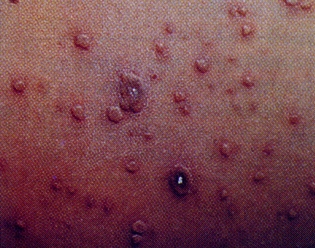
- Crops of small, Red Papules or Vesicles
- Start as Macules and transition to Papules, Vesicles and then Pustules
- In vaccinated patients, lesions remain maculopapular (not vesicular)
- If Immunocompromised, may develop progressive and extensive lesions
- May also appear septic, with multisystem organ involvement
- Lesions are in various stages of healing (contrast with Smallpox in which lesions at same stage)
- No longer contagious when all lesions have crusted (typically after 4-5 days)
- Start as Macules and transition to Papules, Vesicles and then Pustules
- Develop into "Dew Drop on a rose petal" appearance
- Oval, "teardrop" Vesicles
- Erythematous base
- Spread centripetally from head to trunk
- Starts on face and scalp and spreads to trunk and back
- Minimal limb involvement
- May involve oral or vaginal mucosa
- Images
- Crops of small, Red Papules or Vesicles
VII. Differential Diagnosis
- Herpes Simplex Virus
- Herpes Zoster Virus (Shingles)
- Impetigo
- Coxsackie virus
- Papular Urticaria
- Scabies
- Dermatitis Herpetiformis
- Drug rash
-
Smallpox
- Vesicular lesions that are all in the same stage
VIII. Labs: Diagnosis
- Varicella is typically a clinical diagnosis (and formal testing is not typically needed)
- However, consider testing when diagnosis is unclear, especially in pregnancy, Immunocompromised patients
- Varicella PCR
- Preferred diagnostic test when needed
- Sample sources
- Vesicle (punture with needle or unroof and swab the base)
- Lesion crust
- Other tests
- Varicella tissue culture
- Lower Test Sensitivity than PCR, and longer wait
- Vesicular fluid exam (Tzanck Smear)
- Multinucleated giant cells
- Epithelial cells with Eosinophilic inclusion bodies
- Virus
- Varicella Serology
- Varicella IgG titers (obtain acute and convalescent titers)
- Varicella tissue culture
IX. Labs: Other
-
Complete Blood Count (CBC)
- Slight Leukocytosis
- IgG Antibody to VZV (ELISA)
- Immunity testing indicated in pregnancy
X. Management: General
- Reduction of Pruritus
- Calamine Lotion
- Oatmeal Bath (Aveeno)
- Atarax at bedtime
- Prevention of Superinfection
- Apply Bacitracin to denuded lesions until scab forms
- Hospitalization Indications
- Immunocompromised state or pregnancy <20 weeks gestation (see IV protocol below)
- Malignancy (e.g. Leukemia)
- Mortality rates are as high as 30%
- Varicella Complications (e.g. Pneumonia)
- Close observation and consider hospitalization
- Children <1 year old
- Adults with primary varicella (consider admission)
- Mortality >25 fold over that of children
XI. Management: Virus Suppression
- Antiviral therapy is routinely recommended only in patients at higher risk of complications
- Unvaccinated patients >12 years old
- Chronic skin conditions
- Chronic lung disease (e.g. Asthma, COPD, Cystic Fibrosis)
- Patients on Salicylates or Corticosteroids (including Inhaled Corticosteroids)
- Pregnancy (see protocol below)
- Immunocompromised patients (see protocol below)
- Normal host: Acyclovir (or Valacyclovir or Famciclovir)
- Dosing
- Acyclovir 20 mg/kg/dose (up to 800 mg/dose) 5 time per day (or every 4 hours)
- Efficacy
- Shortens time of viral shedding
- Most effective if started within 24 hours of rash (some effect up to 72 hours)
- Faster cessation of new lesions
- Fever duration reduced
- More rapid healing
- Indications
- Consider especially in large household
- Adverse effects
- Avoid if Dehydration present
- Not associated with short-term viral resistance
- References
- Dosing
-
Immunocompromised (including high dose Corticosteroids for >14 days) or pregnancy exposure <20 weeks gestation
- VZIG
- See postexposure protocol below
- Acyclovir
- Initiate as soon as possible with onset of rash
- Indicated within 10 days of rash onset
- Dose: 500 mg/m2/day IV divided q8 hours for 7 days
- VZIG
XII. Prevention: Preexposure
-
Varicella Vaccine (Varivax)
- Vaccinated patients may become infected, but tend to have a milder course
XIII. Prevention: Postexposure Prophylaxis
- Indications
- Exposure between 2 days before rash onset and when all skin lesions have crusted (4 to 5 days) AND
- Not immune
- No history of Varicella Zoster Virus infection and negative Serology or
- Less than 2 doses of Varicella Zoster Virus Vaccine
- Healthy patients
- Varicella Vaccine within 3-5 days of exposure
-
Immunocompromised, pregnant women, or newborns (mother with rash 5 days before or 2 days after delivery)
- Varicella zoster immune globulin (VZIG) 125 units per 10 kg IM
- Avoid delays (best within first 96 hours, but may be given up to 10 days postexposure)
- Immune globulin (IVIG) 400 mg/kg IV
- Give only if VZIG not available
- Varicella zoster immune globulin (VZIG) 125 units per 10 kg IM
- Oral Acyclovir
- Consider for 7-10 days after exposure in Immunocompromised children without Varicella Immunity
- References
XIV. Course
- Incubation Period: 11-21 days
- Infectious
- Start: 1-3 days before rash
- End: Final lesion crusted (4-5 days after rash onset)
XV. Complications: General
- Highest complication rates are in infants age <1 year
- Teens and adults also have higher complication rates
- Lowest complication rates in young children and pre-teen (age 1 to 12 years)
- Progressive varicella (Immunocompromised patients)
- Extensive lesions developing over a longer course
- Sepsis and multiorgan involvement may occur
-
Lung involvement (14-30% of adults)
- Viral PneumoniaIncidence 1 case per 400 adult cases
- Secondary Bacterial Pneumonia
-
Encephalitis
- Occurs in 1.8 per 10,000 varicella infections
-
Acute Cerebellar Ataxia
- Occurs in 1 per 4000 varicella infections in children <15 years old
-
Herpes Zoster
- Unvaccinated children <18 years will develop zoster in 230 per 100,000 Varicella cases
- Secondary Bacterial Infection (superinfection) common (esp. if fever>5 days)
- Cellulitis
- Abscess
- Erysipelas
- Otitis Media
- Invasive Group A Beta-hemolytic Streptococcus
- Septic Arthritis
- Osteomyelitis
- Staphylococcal pyomyositis
- Disseminated disease in Immunocompromised
-
Reye's Syndrome
- Avoid concurrent Aspirin use in children
- Nephritis
- Varicella mortality
XVI. Complications: Congenital Syndrome (Pregnancy related)
-
General
- Non-immune Mother exposed to Varicella Zoster Virus
- Congenital syndrome risk 13-20 weeks gestation (2% risk if mother has varicella)
- Not associated with Pregnancy loss
- Not associated with Preterm Labor
- Infant Findings
- Skin lesions
- Short limbs and digits
- Ocular abnormalities
- Muscular atrophy
- Intrauterine Growth Retardation
XVII. References
- Harrison and Ruttan (2019) Crit Dec Emerg Med 33(7): 3-12
- Harrison and Ruttan (2023) Crit Dec Emerg Med 38(2): 23-31
- Doctor (1995) Pediatrics 96:428-33 [PubMed]
- Spencer (2017) Am Fam Physician 95(12): 786-94 [PubMed]