
II. Epidemiology
- Most common in children under age 2 years
- Endemic to tropical areas
- Incidence: Affects 100-300 million persons per year (worldwide)
III. Risk Factors
- Young children
- Crowded living conditions (Nursing Homes, shelters)
- Poor hygiene
- Poor nutritional status
- Homelessness
- Dementia
- Sexually Transmitted Disease
- Immunocompromised
- Tropical region
IV. Pathophysiology
- Images
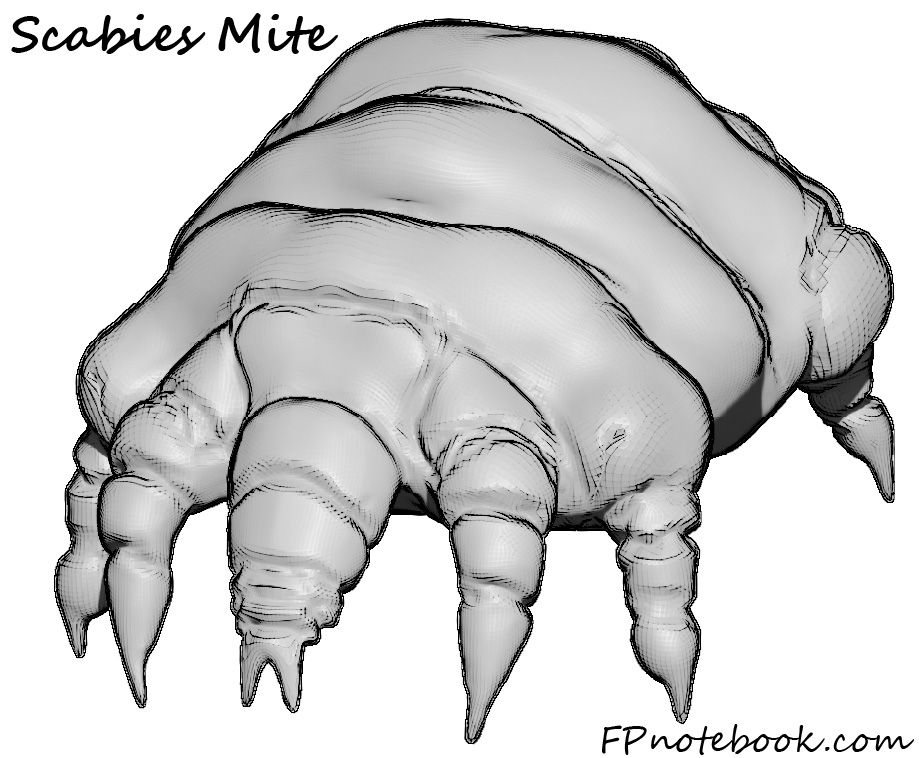
- Caused by mite infestation: Sarcoptes scabiei
- Life cycle of female mite (30 days)
- Male and female mite mate on skin and then male mite dies
- Female mite burrows into skin to lay eggs
- Lays 10 to 25 eggs over 4-6 weeks (1-3 eggs/day)
- Female dies after laying eggs
- Eggs hatch within 3-4 days
- Scabies larvae mature into adults in 14-17 days
- New mites cut through burrow to skin surface to begin cycle again
- Scabies mite can travel 2.5 cm/minute
- Mites cannot jump or fly
- Mites can live up to 3 days without a human host
- Mites can complete life cycle without host symptoms
- Transmission with any contact including with fomites
- Prolonged skin contact for at least 15-20 minutes (usually not a handshake)
- Exception: Hyperkeratotic Crusted Scabies can be transmitted with brief contact
- Hospitals and Nursing Homes
- Day cares
- Household contact
- Sexual contact
- Shared clothing or bedding
- Fomite transmission is rare
- Prolonged skin contact for at least 15-20 minutes (usually not a handshake)
- No significant transmission from pets with Scabies (mange)
- Mite may be passed from pet (esp. dogs) but they do not survive
- Short-term itching may occur but resolves in days
V. Symptoms
- Severe, intense diffuse itch at incubation (Hypersensitivity Reaction to mite feces)
- Symptoms worse at night, interfering with sleep
- Few other pruritic dermatoses cause such intense night Pruritus
-
Failure to Thrive in Infants
- Infants have worse course with diffuse involvement
VI. Signs
- Characteristics
- Onset or incubation
- Initial infestation: Symptoms occur 6-8 weeks after exposure (delayed Hypersensitivity Reaction)
- Subsequent infestation: Symptoms may occur within 2 days of exposure
- Initial: Tiny to small erythematous Papules (<5 mm)
- Next: Vesicles or Pustules may form
- Pathognomonic: Burrow (present in 10-20% of cases)
- May appear as short, Scaling, 1-10 mm long, wavy gray lines on surface of skin
- Marks the course of mite tunneling through Epidermis (typically Stratum Corneum)
- Most easily seen on web spaces, wrists and elbows
- Burrow Ink Test (BIT Test)
- Color burrows with magic marker and then washing the area
- Marker will infiltrate the burrows, and the burrows will be more evident
- May appear as short, Scaling, 1-10 mm long, wavy gray lines on surface of skin
- Secondary to scratching
- Excoriations, crusts
- Secondary Skin Infections
- More intense inflammatory response in some cases
- Background erythema
- Deep Nodules
- Onset or incubation
- Distribution
- Infants
- Children and adults (especially flexor surfaces)
- Spares face and scalp
- Hands and wrists
- Digital web spaces
- Sides of fingers
- Volar wrist
- Lateral palm
- Axillae
- Elbow and Antecubital fossa
- Trunk (may appear as a diffuse erythematous rash as Hypersensitivity Reaction)
- Adults (includes sites for children above)
- Variant: Hyperkeratotic Crusted Scabies (Norwegian Scabies)
- Pathophysiology
- Very contagious
- Occurs in older, debilitated, Immunocompromised patients living in close quarters (e.g. Nursing Home)
- Infestations involve hundreds to more than a thousand mites (contrast with 10-15 typically)
- Symptoms
- Pruritus is paradoxically mild or absent despite the severity of the infestation
- Lack of inflammatory response
- Signs
- Thick (hyperkeratotic) crusted Plaques on hands and feet (especially palmar and plantar surfaces)
- Thick, dystrophic Fingernails and Toenails
- Red, Scaling lesions with generalized distribution may appear as Xerotic Eczema (Dry Skin)
- Scalp is often involved
- Pathophysiology
VII. Diagnosis
- Precautions
- Scabies is misdiagnosed in 45% of cases (often when made without microscopy or Dermoscopy)
- Preferred diagnosis is based on identifying a mite, eggs or scybala
- Alternative diagnostic criteria (empiric treatment criteria)
- Pruritus AND
- Lesions typical of Scabies on at least two body sites OR other household members have Pruritus
- Page (2007) J Fam Pract 56(7): 570-2 [PubMed]
- Search for burrows holding gravid female mite
- Consider Burrow Ink Test (BIT Test) in signs as above
- Typical infestations involve 10-15 mites
- Often found on nipples, axillae, hands and genitalia
- Find newest lesions and least disturbed skin
- Check beneath finger nail edge
- Scrape Burrow or other lesions
- Technique
- Apply drop of Mineral Oil to skin burrow
- Scrape burrow longitudinally with #15 blade along length of burrow (avoid causing bleeding)
- Transfer the skin scraping with oil to a glass slide
- Microscopy under low power in oil for:
- Mite (female is 0.4 mm, male is 0.2 mm)
- Eggs
- Scybala (Mite feces)
- Potassium Hydroxide (KOH)
- Dissolves scybala
- Technique
-
Dermoscopy
- Fewer False Negatives than microscopy
- Skin Biopsy
- Consider in refractory cases in which the diagnosis is elusive
VIII. Differential Diagnosis
- See Pruritus
- Other cutaneous infestations
- Miscellaneous conditions
IX. Management
-
General
- Treat all household contacts who sleep in same room
- Treat sexual partners for the last 2 months
- Environmental control measures (start on the morning after the treatment application)
- Wash in hot water (122-140 F or 50-60 C) and dry all clothing and bedding used in the last 48 hours
- Items that cannot be washed can be placed in a plastic bag for at least 1 week
- Vacuuming may be helpful
- Itching will persist up to 2-6 weeks after treatment
- Pruritus clears as skin sloughs mite debris
- See Pruritus Management for general measures
- Consider Pruritus Management after treatment
- Topical Corticosteroids (low to medium potency such as triamcinolone)
- Oral Antihistamine (e.g. Benadryl, Atarax or Zyrtec)
- Oral Corticosteroids for 5-7 days (severe diffuse Pruritus)
- Body or Genital Scabies (follow links to agents below regarding usage)
- First Line
- Permethrin (Elimite) 5% cream
- Apply to all areas of body from neck down
- Apply to all cracks and crevices (including perineum)
- Infants (age<1 year old) and Immunocompromised should also apply to face and head
- Healthy adults and children >1 year old need not apply to face and head
- Leave on overnight for 8-14 hours
- Wash off in morning
- Reapply in one week
- Supply adults with 60 grams (30 grams per application)
- Two doses typically cost $25 in 2019
- May be used in infants over age 2 months
- Pregnancy Category B
- Apply to all areas of body from neck down
- Permethrin (Elimite) 5% cream
- Second Line
- Ivermectin (Stremectol)
- Avoid in pregnancy and children under 15 kg (33 lb)
- May be used during Lactation
- Give 200 mcg/kg orally now and repeat in 7-14 days
- Adults will typically require 4-6 tablets per dose
- Total cost of 2 doses in 2019 is approximately $50
- Indications
- Patients unable to apply the cream (bed-ridden, institutionalized)
- Scabies refractory to Permethrin
- Generalized crusted Scabies
- Ivermectin (Stremectol)
- Other agents
- Precipitated Sulfur in petrolatum or other ointment at 6% (compounded)
- Has been used in newborns, pregnancy, Lactation
- No safety or efficacy data available
- Applied head to toe
- Leave on 24 hours
- Repeat application daily for 3 days total
- Change bed linen as treatment is completed
- Stings!
- Crotamiton (Eurax) 10% cream
- Used in nodular Scabies or as an alternative to other agents
- Apply and leave on for 24 hours, then wash and reapply for up to 3-5 days
- Safe in pregnancy, Lactation and infants
- Efficacy: 50-70%
- Precipitated Sulfur in petrolatum or other ointment at 6% (compounded)
- Agents not recommended
- Permethrin 1% (OTC Nix Creme Rinse)
- Too low a concentration to be effective (use the 5% Permethrin instead)
- Lindane (Kwell, Gamma Benzene Hexachloride) 1% Lotion
- Avoid due to neurotoxicity (systemic absorption is 10 fold more than Permethrin)
- Higher risk with broken skin and young children
- Higher resistance rates than other agents
- Permethrin 1% (OTC Nix Creme Rinse)
- First Line
-
Crusted Scabies (Norwegian Scabies)
- Environmental control measures
- See general measures as above
- Use barrier protection (gloves)
- Treat exposures
- Dual medication therapy
- Permethrin 5% cream daily to full body for 7 days, then twice weekly until cure AND
- Ivermectin 200 mcg/kg orally on days 1, 2, 8, 9, and 15
- Environmental control measures
X. References
- DeClerck and Swadron in Herbert (2015) EM:Rap 15(10):18-19
- Marco (2013) Crit Dec in Emerg Med 27(1): 2-7
- Angel (2000) Pediatr Clin North Am 47(4):921-35 [PubMed]
- Finders (2004) Am Fam Physician 69(2):341-50 [PubMed]
- Gunning (2012) Am Fam Physician 86(6): 535-41 [PubMed]
- Potts (2001) Postgrad Med 110(1):57-64 [PubMed]
- Roos (2001) Drugs 61(8):1067-88 [PubMed]