Hematology and Oncology Book

http://www.fpnotebook.com/

Red Blood Cell Physiology

Aka: Red Blood Cell Physiology, Hemoglobin Production, Hemoglobin A2, Hemoglobin A, Hemoglobin F, Hemoglobin H, Hemoglobin Bart, Iron
Advertisement
  1. Physiology: Erythropoietin
    1. Primary hormone regulator of RBC production
    2. Erythropoietin sources
      1. Fetus: Monocyte and Macrophage system in liver
      2. Postnatal: Peritubular cells in Kidney
  2. Physiology: Iron
    1. Total Body Iron
      1. Men: 50 mg/kg (or 3.8 grams for 75 kg man)
      2. Women: 42 mg/kg (or 2.3 grams for 55 kg woman)
    2. Normal adult iron distribution
      1. Functional iron (70%)
        1. Hemoglobin component (80%)
        2. Myoglobin
        3. Intracellular respiratory enzymes (cytochromes)
      2. Storage or transport iron (30%)
        1. Ferritin (primary storage)
        2. Hemosiderin
        3. Transferrin (iron transport)
    3. Iron Loss
      1. Men and non-menstruating women: 1 mg iron/day
      2. Menstruating women: 1.6 to 2.5% more per day
        1. Blood loss varies widely per Menstrual Cycle
        2. Average loss: 10 mg iron/cycle
        3. Blood loss may approach 42 mg/cycle in heavy flow
      3. Pregnancy: 700 mg iron lost
      4. Whole blood donation (500 cc): 250 mg iron lost
  3. Physiology: Red Blood Cell
    1. Hemoglobin produced until amounts to 90% of RBC mass
    2. Red Blood Cells start as Reticulocytes in Bone Marrow
      1. Reticulocytes are juvenile Red Blood Cells
        1. Nucleus extruded once RBC has matured
        2. Reticulocytes contain ribosome remnants
          1. Immature Reticulocytes contain most ribosomes
          2. Mature Reticulocytes contain least ribosomes
      2. Reticulocytes have 4 day life span
        1. Bone Marrow: 3 days (less if Erythropoietin high)
        2. Peripheral blood: 1 day
    3. Red Blood Cell survival
      1. Normal RBC: 120 days
      2. Abnormal RBC: May survive as little as 15 days
      3. Following transfusion: RBC survival 2-3 weeks
  4. Physiology: Hemoglobin
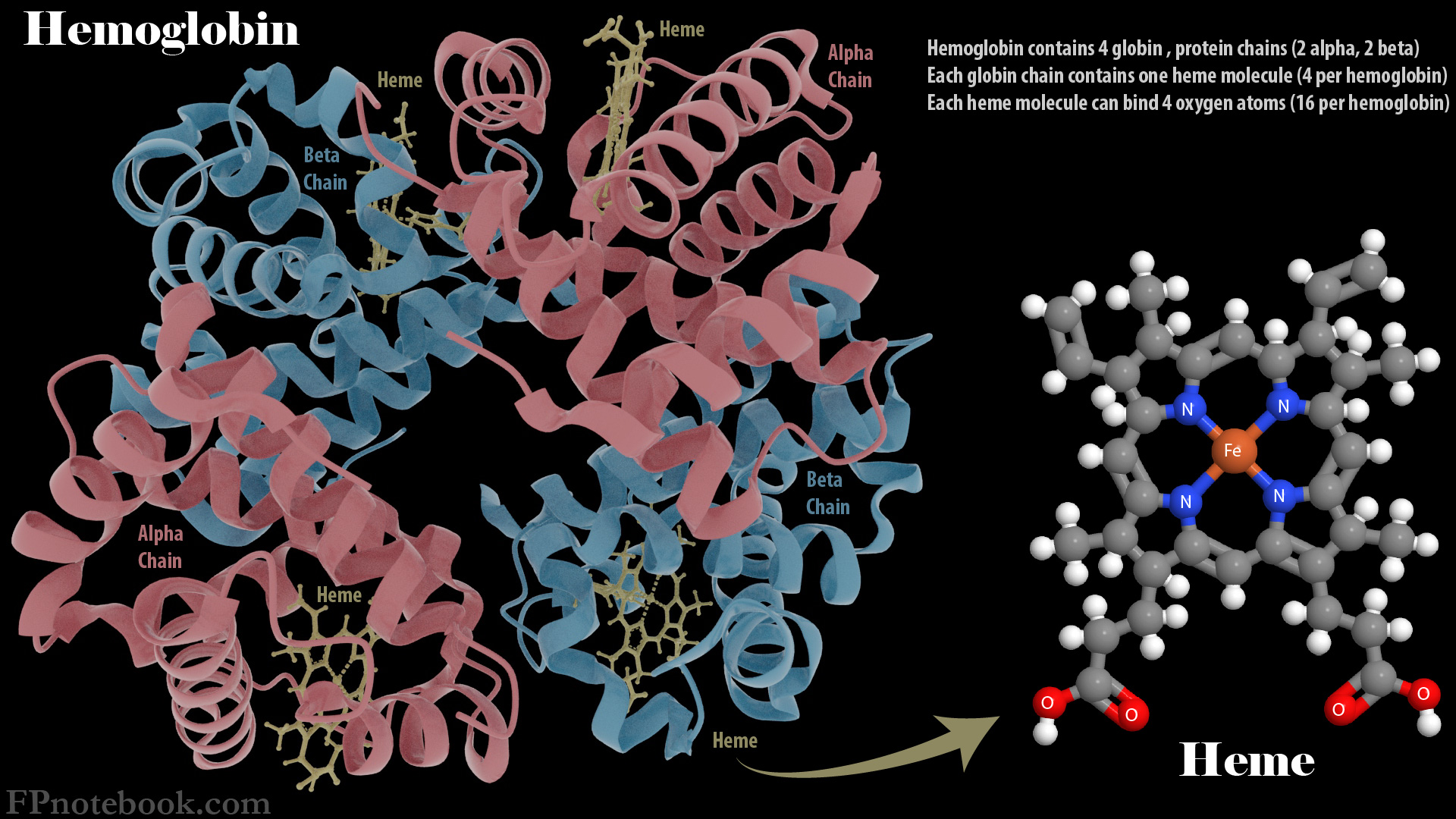
    1. Heme protein complex
      1. Central iron-containing heme ring attached to
      2. Two pairs of polypeptides (4 total)
        1. A pair of alpha chains are found in every normal Hemoglobin type
        2. A pair of other polypetides depending on type (Gamma, Beta, Delta)
    2. Six types of normal Hemoglobin
      1. Embryonic
      2. Gower I
      3. Gower II
      4. Portland
      5. Fetal Hemoglobin (HbF): Alpha2-Gamma2
        1. Primary Hemoglobin in fetus
        2. Replaced by Adult Hemoglobin by age 6-12 months
      6. Adult Hemoglobin (HbA): Alpha2-Beta2
      7. Adult Hemoglobin (HbA2): Alpha2-Delta2
    3. Thalassemia related Hemoglobins
      1. Hemoglobin Bart's: Gamma4
        1. Seen in Alpha Thalassemia
      2. Hemoglobin H: Beta4
        1. Seen in Beta Thalassemia
  5. References
    1. (1998) MMWR Morb Mortal Wkly Rep 47:1-29
  6. Resources
    1. MMWR Iron Deficiency Anemia Prevention
      1. http://www.cdc.gov/mmwr/pdf/rr/rr4703.pdf

Iron (C0302583)

Definition (MSH) A metallic element with atomic symbol Fe, atomic number 26, and atomic weight 55.85. It is an essential constituent of HEMOGLOBINS; CYTOCHROMES; and IRON-BINDING PROTEINS. It plays a role in cellular redox reactions and in the transport of OXYGEN.
Definition (MEDLINEPLUS)

Iron is a mineral that our bodies need for many functions. The body needs iron to make the proteins hemoglobin and myoglobin. Hemoglobin is found in red blood cells and myoglobin is found in muscles. They help carry and store oxygen in the body. Iron is also part of many other proteins and enzymes in the body.

Your body needs the right amount of iron. If you have too little iron, you may develop iron deficiency anemia. Causes of low iron levels include blood loss, poor diet, or an inability to absorb enough iron from foods.

Too much iron is toxic to your body. Taking too many iron supplements can cause iron poisoning. Some people have an inherited disease called hemochromatosis. It causes too much iron to build up in the body.

Definition (NCI) An important mineral the body needs to make hemoglobin, a substance in the blood that carries oxygen from the lungs to tissues throughout the body. Iron is also an important part of many other proteins and enzymes needed by the body for normal growth and development. It is found in red meat, fish, poultry, lentils, beans, and foods with iron added, such as cereal.
Definition (CSP) metallic element found in certain minerals, in nearly all soils, and in mineral waters; atomic symbol Fe, atomic number 26, and atomic weight 55.85; it is an essential constituent of hemoglobin, cytochrome, and other components of respiratory enzyme systems; chief function is in the transport of oxygen to tissue (hemoglobin) and in cellular oxidation mechanisms.
Definition (NCI) An element with atomic symbol Fe, atomic number 26, and atomic weight 55.85.
Definition (PDQ) An element with atomic symbol Fe, atomic number 26, and atomic weight 55.85. Check for "http://www.cancer.gov/Search/ClinicalTrialsLink.aspx?id=42183&idtype=1" active clinical trials or "http://www.cancer.gov/Search/ClinicalTrialsLink.aspx?id=42183&idtype=1&closed=1" closed clinical trials using this agent. ("http://nciterms.nci.nih.gov:80/NCIBrowser/ConceptReport.jsp?dictionary=NCI_Thesaurus&code=C598" NCI Thesaurus)
Concepts Pharmacologic Substance (T121) , Biologically Active Substance (T123) , Element, Ion, or Isotope (T196)
MSH D007501
SnomedCT 350552003, 3829006, 30729008, 373755001
English iron, Iron preparation, NOS, Iron product, Iron, NOS, FE, Fe, Iron drug, iron preparations (medication), iron preparations, hematinics iron preparations, Iron product (product), IRON, Iron [Chemical/Ingredient], [TN410] IRON, iron preparation, Fe element, Fe - Iron, Iron preparation, Iron (substance), Iron agent (substance), Iron agent, Iron preparation (product), Iron preparation (substance), Iron, ferric ion
Swedish Järn
Czech železo
Spanish Iron product, hierro (producto), preparado con hierro (producto), preparado con hierro, agente con hierro (sustancia), agente con hierro, hierro (sustancia), hierro, preparado de hierro (producto), preparado de hierro (sustancia), preparado de hierro, Hierro
Finnish Rauta
Russian ZHELEZO, ЖЕЛЕЗО
Croatian ŽELJEZO
Latvian Dzelzs
Polish Żelazo
French Fer
German Eisen
Italian Ferro
Portuguese Ferro
Sources
Derived from the NIH UMLS (Unified Medical Language System)


Navigation Tree