
II. Imaging: Views
- Standard
- Anterior-Posterior XRay (or Posterior-Anterior XRay)
- True AP View needed to isolate the two rows of Carpal Bones (oblique view obscures Fractures)
- Evaluate for Scaphoid Fracture, Scapholunate Dissociation and other Carpal BoneFractures
- Lateral XRay
- Anterior-Posterior XRay (or Posterior-Anterior XRay)
- Special
- Scaphoid Fracture suspected
- Scaphoid View
- Pisiform Fracture or hook of hamate Fracture suspected
- Carpal Tunnel view
- Supinated oblique view
- Scapholunate Dissociation
- Clenched-fist view
- Supinated wrist with ulnar deviation
- Scaphoid Fracture suspected
III. Imaging: Other imaging modalities
-
Wrist Ultrasound
- Evaluates soft tissue (tendon, synovium)
- Variable efficacy based on operator
- Bone scan
- Finds occult Fractures (Scaphoid), Stress Fractures
- Highly sensitive but not specific for Fracture
- Wrist CT Scan
- Identifies Fractures and articular subluxations
-
Wrist MRI
- Identifies Fractures and soft tissue injuries
- Expensive, but most sensitive and specific study
IV. Evaluation: Interpretation
- Post-Reduction Wrist XRay confirms normal radius length
- Images
- AP View
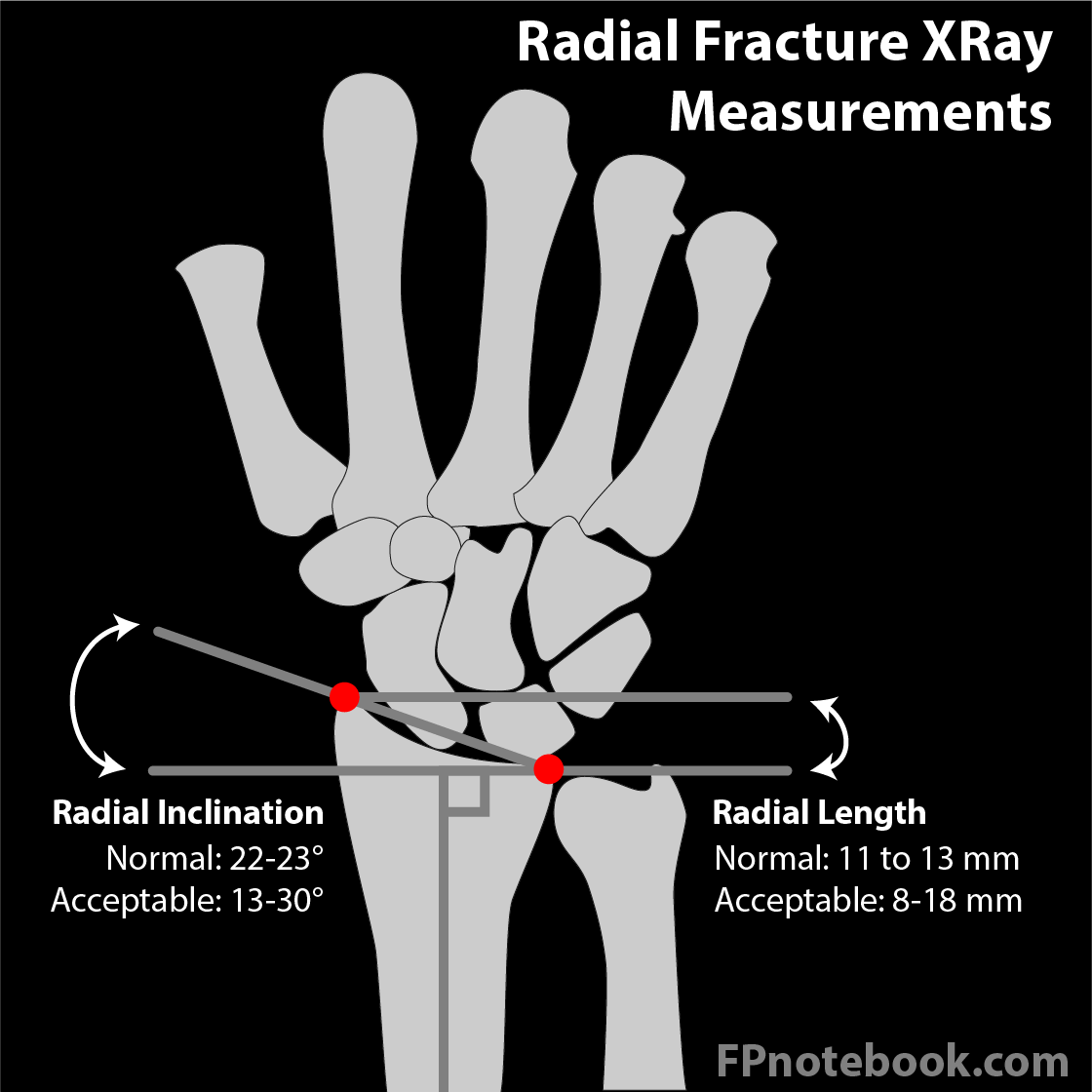
- Landmarks on AP View at distal radius
- Distal line (line 1)
- Draw a horizontal line at the level of the radial styloid at the distal radius (point A)
- Represents the distal most point of the radial articular surface
- Proximal line (line 2)
- Draw a horizontal line at the level of the ulnar articulation of the medial distal radius (point B)
- Represents the distal most point of the radial-ulnar articular surface
- Radial length (Radial Height) represents the distance between distal line 1 and proximal line 2
- Articular plane (line 3)
- Draw a line between the points A and B above (between ulnar aspect of radius and ulnar styloid)
- Radial Inclination represents the angle between Line 1 (proximal transverse) and this oblique Line 3
- Distal line (line 1)
- Normal anatomic relationships
- Radial Inclination (normal measurements are for adults)
- Angle formed between the articular plane and the proximal line (see above)
- Normal Radial Inclination: 23.6 +/- 2.5 degrees
- Acceptable inclination: 13-30 degrees
- Radial Height (radial length) shortening (normal measurements are for adults)
- Distance between the proximal and distal lines (see above)
- Normal Radial Height: 11-12 mm
- Acceptable Radial Height: 8-18 mm
- Gilula Lines (3 carpal arcs)
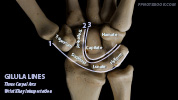
- Three intact arcs indicate normal carpal alignment on the AP View
- Disrupted arc may indicate Ligamentous Injury or Fracture
- Radial Inclination (normal measurements are for adults)
- Landmarks on AP View at distal radius
- Lateral View
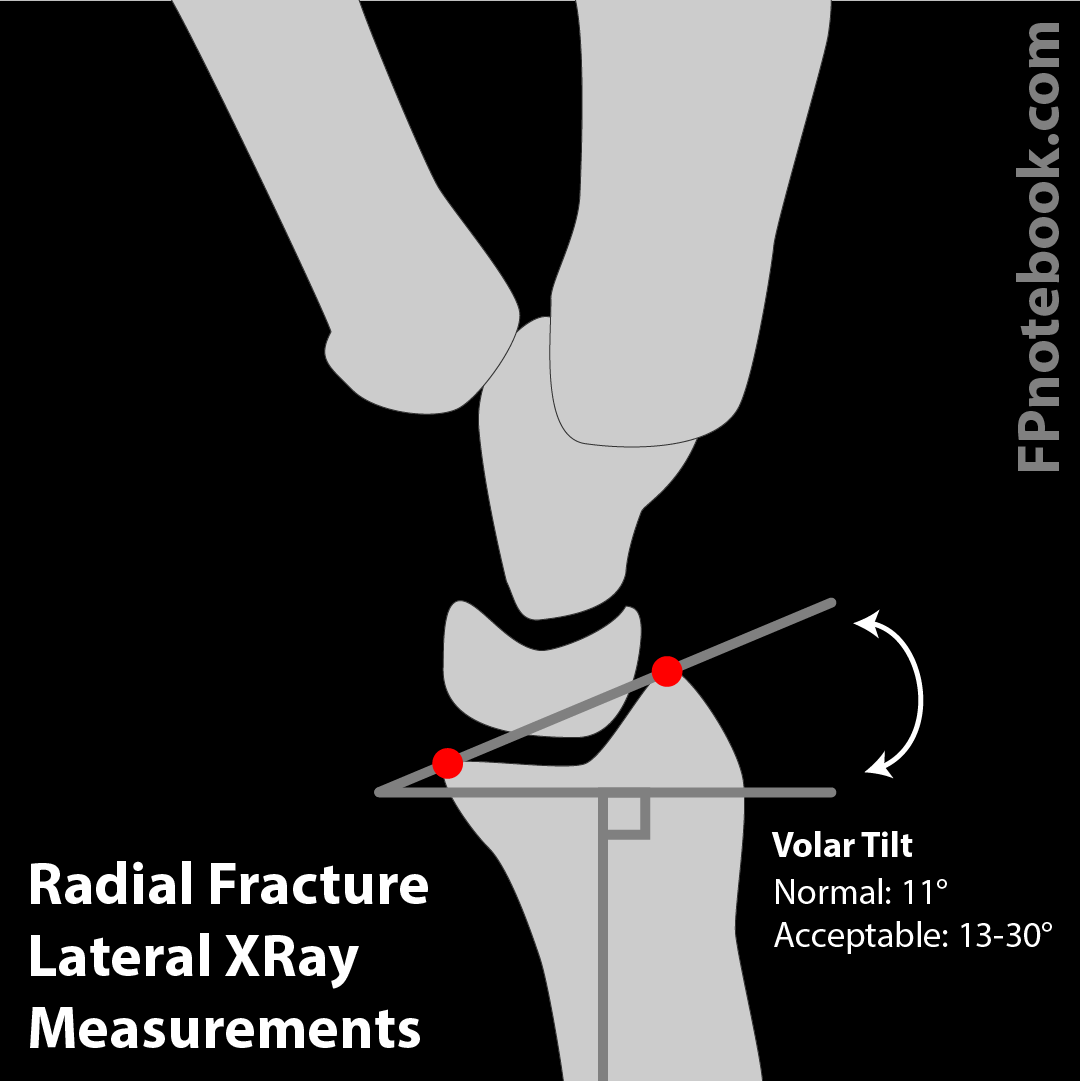
- Landmarks on Lateral View at distal radius
- Distal dorsal rim
- Point on the distal radius at the dorsal aspect
- Distal volar rim
- Point on the distal radius at the volar aspect
- Vertical line at distal radius
- Perpendicular to the long axis of the radius
- Volar Tilt Line
- Line drawn between distal dorsal rim and distal volar rim
- Distal dorsal rim
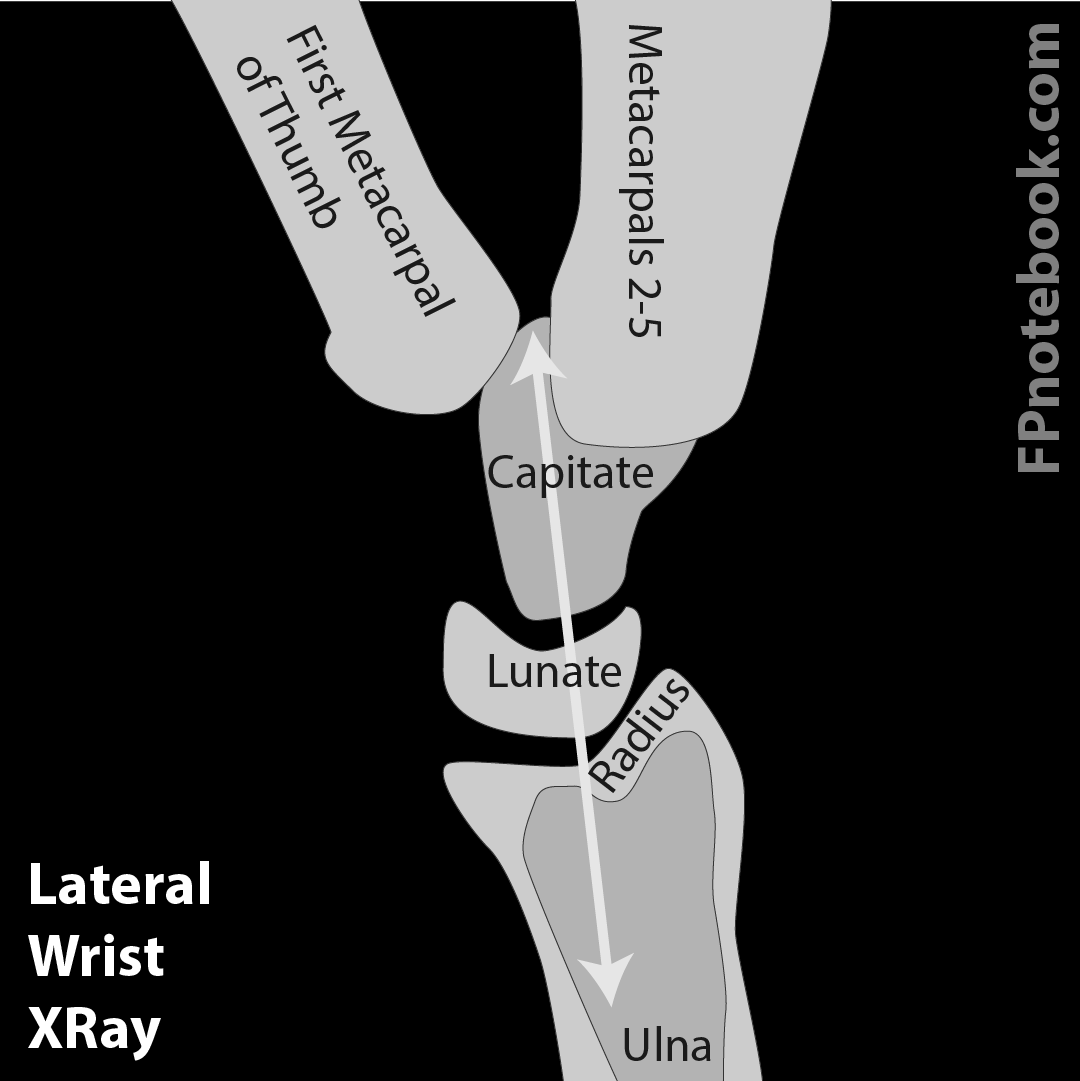
- Appearance of tea cup and saucer (4Cs)
- Proximal Capitate (most distal C)
- Distal Lunate Bone
- Proximal Lunate Bone (crescent shape)
- Distal radius (most proximal C)
- Normal anatomic relationships
- Volar Tilt angle: 11.2 +/- 4.6 degrees
- Angle formed between Volar Tilt line and vertical line at distal radius
- Radius articular surface directed down, forward, in
- Ulnar styloid points to the more Triquetrum Bone
- Normal fat stripe volar to the distal radius on lateral view
- Represents the border of the pronator quadratus
- Fat stripe displaced or compressed in Wrist Injury with swelling or Hematoma
- Volar Tilt angle: 11.2 +/- 4.6 degrees
- Landmarks on Lateral View at distal radius
- Oblique View
- Primarily evaluates the proximal Carpal Bone row (esp. Scaphoid Bone) and thumb base
- May also demonstrate TriquetrumFracture

V. Findings
- Forearm Fracture
-
Distal Radius Fracture
-
Colles Fracture
- Dinner fork deformity
- Fracture apex volar with dorsal angulation of distal fragment
-
Smith Fracture
- Inverse of Colles Fracture
- Fracture apex dorsal, and volar angulation of the distal fragment
-
Barton Fracture
- Smith Fracture with intraarticular involvement
-
Colles Fracture
-
Wrist bone Fracture
- Scaphoid Fracture (60-70% of carpal Fractures, esp. FOOSH injuries)
- Best seen on oblique view (or dedicated Scaphoid view)
- Associated with other Fractures in 5-12% of cases
- False Negative first XRay in up to 30% of cases
- TriquetrumFracture (TriquetralFracture)
- Scaphoid Fracture (60-70% of carpal Fractures, esp. FOOSH injuries)
-
Wrist Dislocations on AP View
- Distal Radius Ulna Joint (DRUJ) Disruption
- Distal radius and ulna should slightly overlap on AP film
- DRUJ Disruption is an unstable wrist condition
- Scapholunate Dissociation
- Wide gap (>2 mm in adults) between Scaphoid and Lunate Bones on AP View (Terry Thomas Sign)
- Scapholunate distance on AP View is normally 1-2 mm in adults (may appear wider in children)
- Should normally be roughly similar to other Carpal Bone distances
- Scaphoid Rotary Subluxation
- Distal Radius Ulna Joint (DRUJ) Disruption
-
Wrist Dislocations on Lateral View (disrupted 4Cs)
- Lunate Dislocation (volar Lunate Dislocation, "spilled teacup sign")
- Perilunate Dislocation (dorsal Capitate dislocation)
- Spectrum of ligament disruption (complete disruption results in complete dislocation)
- Children
VI. References
- Tubbs and Janicki (2025) Wrsit XRay, Mastering Emergency Imaging, CCME, accessed 2/15/2026
- Medoff (2005) Hand Clin 21(3): 279-88 [PubMed]