http://www.fpnotebook.com/
Dizziness
Aka: Dizziness, Faintness- Types: Dizziness Causes
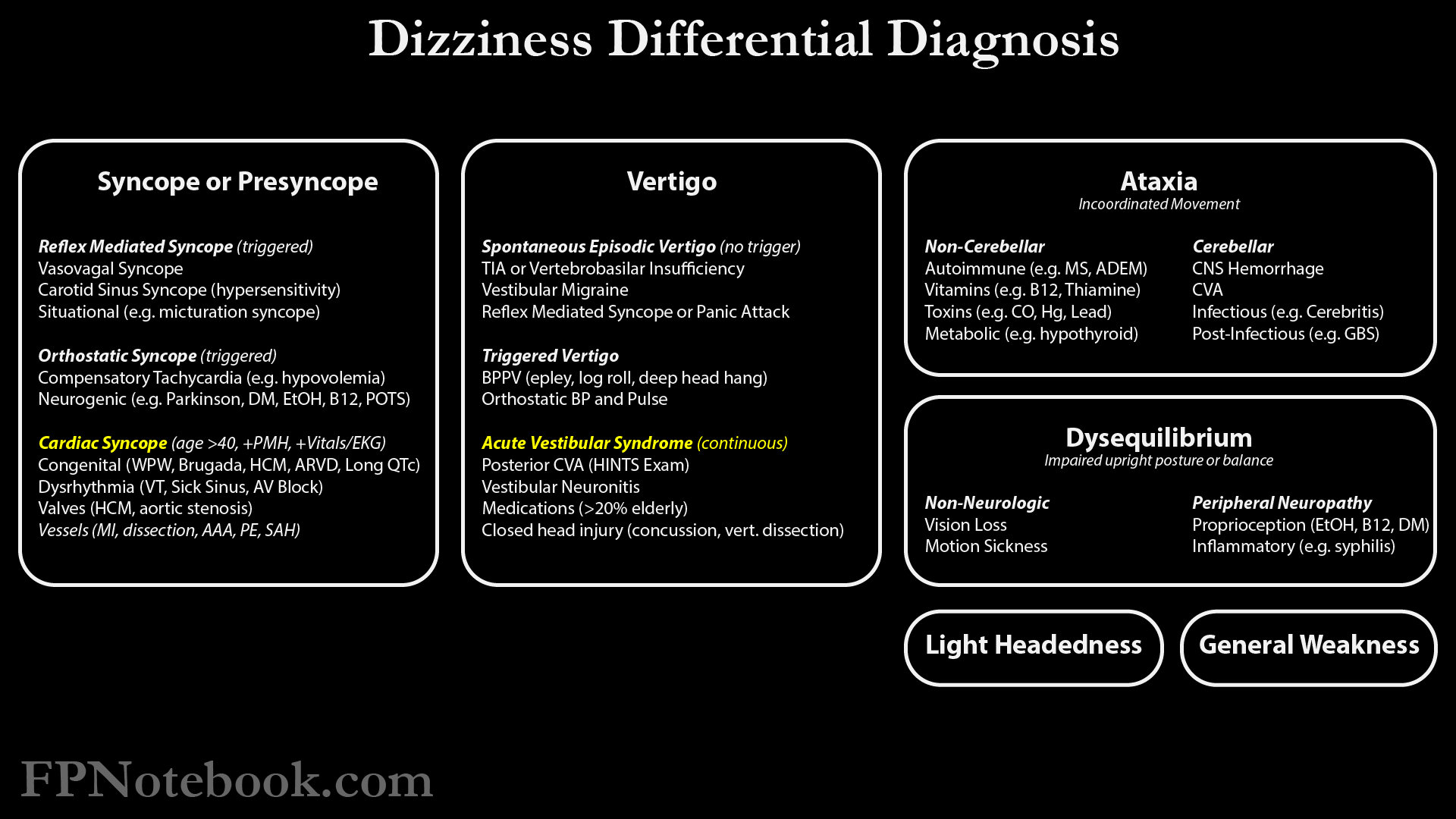
- Vertigo (45-54%)
- Sense of motion (e.g. spinning) despite being still
- Examples
- Benign Paroxysmal Positional Vertigo
- Vesitbular Neuronitis
- Meniere Disease
- Vestibular Migraine
- Associated Conditions
- Dysequilibrium (16%)
- Off-balance
- Examples
- Presyncope (14%)
- Sensation of loss of consciousness
- Examples
- Associated Conditions
- Lightheadedness (10%)
- Vague sensations not fitting in above categories
- Examples
- Hypoventilation Syndrome
- Associated Conditions
- Vertigo (45-54%)
- References
Syncope (C0039070) |
|
|---|---|
| Definition (NCI) | A spontaneous loss of consciousness caused by insufficient blood supply to the brain. |
| Definition (NCI) | A disorder characterized by spontaneous loss of consciousness caused by insufficient blood supply to the brain. |
| Definition (NCI) | Extremely weak; threatened with syncope. |
| Definition (MEDLINEPLUS) |
If you've ever fainted, you are not alone - at least one third of people faint sometime in their lives. Fainting is a temporary loss of consciousness. You lose muscle control at the same time, and may fall down. Most people recover quickly and completely. Fainting usually happens when your blood pressure drops suddenly, causing a decrease in blood flow to your brain. This is more common in older people. Some causes of fainting include
Fainting is usually nothing to worry about, but it can sometimes be a sign of a serious problem. If you faint, it's important to see your health care provider and find out why it happened. |
| Definition (MSH) | A transient loss of consciousness and postural tone caused by diminished blood flow to the brain (i.e., BRAIN ISCHEMIA). Presyncope refers to the sensation of lightheadedness and loss of strength that precedes a syncopal event or accompanies an incomplete syncope. (From Adams et al., Principles of Neurology, 6th ed, pp367-9) |
| Definition (CSP) | fainting due to a sudden fall of blood pressure below the level required to maintain oxygenation of brain tissue. |
| Definition (NCI) | Extremely weak; threatened with syncope. |
| Concepts | Sign or Symptom (T184) |
| MSH | D013575 |
| ICD9 | 780.2 |
| ICD10 | R55 |
| SnomedCT | 206727002, 206725005, 206731008, 158137001, 158135009, 271211004, 158133002, 271594007, 309585006, 272030005, 29423006, 271785004, 139532000, 162263008 |
| English | Faintness, Fainting, Syncope, Syncopes, FAINTING EPISODES, COLLAPSE FLEETING, COLLAPSE TRANSIENT, FAINTNESS, FALLING OUT, Fainted, PASSED OUT, SWOONING, SYNCOPE, Syncope, NOS, Syncope and collapse NOS, [D]Syncope, [D]Syncope and collapse, [D]Syncope and collapse NOS, A faint, Passed out, [D]Fainting (context-dependent category), [D]Syncope and collapse (context-dependent category), [D]Syncope and collapse NOS (context-dependent category), [D]Fainting, fainting (syncope), syncope, fainting, fainting (symptom), [D]Syncope and collapse NOS (situation), [D]: [fainting] or [collapse] (situation), [D]: [fainting] or [collapse] (disorder), [D]Syncope and collapse (situation), Syncopal attack, Falling out, Swooning, [D]Fainting (situation), Faint, FAINT, FAINTING, Syncope [Disease/Finding], attacks syncopal, disorders syncope, fainting episodes, falls out, Attack(s);fainting, collapse syncope, faint, fainted, faints, syncope attack, out pass, pass out, attacks fainting, out passed, syncopes, fainting/syncope, Swoon, faintings, syncope fainting, faintness, swoons, out passes, swooning, passed out, syncope collapse, fainting syncope, Syncope and collapse, Syncope symptom, Syncope attack, Syncope (disorder), Syncope and collapse (disorder), Syncope symptom (disorder), Fainting/syncope, attack; syncope, attack; unconsciousness, collapse; general, fainting; fit, fit; fainting, general; collapse, loss of consciousness; attack, syncope; syncope, unconsciousness; attack, Faint symptom, Fainting (finding), Fainting [D], Syncope (finding), [D]: [fainting] or [collapse], Collapse fleeting, Collapse transient, fainting attacks, swoon |
| French | SYNCOPE, Collapsus passager, Tendance lipothymique, Syncope et collapsus, Ivre mort, Evanouissements, Collapsus transitoire, Chutes fréquentes, Pâmoison, Lipothymie, COLLAPSUS TRANSITOIRE, DECES, ETAT SYNCOPAL, EVANOUISSEMENT, Evanouissement/syncope, PERTE DE CONNAISSANCE, Syncope, Évanouissement |
| Portuguese | SINCOPE, DESMAIO, Síncope e colapso, Ataque de síncope, Colapso transitório, Esvaimento, Perda de consciência, Desmaiado, Colapso passageiro, COLAPSO TRANSITORIO, DEBILIDADE, DESFALECIMENTO, DESMAIADO, Desmaio/sincope, Desmaio, Síncope |
| Spanish | DESVANECIMIENTO, SINCOPE, DESMAYO, Colapso transitorio, Desfallecimiento, Episodio sincopal, Síncope y colapso, Privación de sentido, Alferecía, Pérdida de conocimiento, Desvanecimiento, Colapso fugaz, [D]desvanecimiento (categoría dependiente del contexto), [D]síncope y colapso (categoría dependiente del contexto), [D]síncope y colapso SAI (categoría dependiente del contexto), Faint symptom, [D]Syncope and collapse NOS, [D]Syncope and collapse, Collapse [D], Fainting [D], Syncope symptom, [D]: [fainting] or [collapse], CAIDA, COLAPSO TRANSITORIO, DESFALLECIMIENTO, Desmayo/sincope, [D]síncope y colapso SAI, [D]síncope y colapso SAI (situación), [D]desvanecimiento (situación), [D]desvanecimiento, [D]síncope y colapso (situación), [D]síncope y colapso, síncope (trastorno), síncope - síntoma (trastorno), síncope - síntoma, síncope y colapso (trastorno), síncope y colapso, síncope, desmayo, desvanecimiento (hallazgo), desvanecimiento, síncope (hallazgo), Sincope, Desmayo, Síncope |
| German | SYNKOPE, ohnmaechtig, Kollaps fluechtig, synkopale Attacke, schwach, bewusstlos werden, Synkope und Kollaps, Kollaps voruebergehend, schwummrig, ohnmaechtig werden, Ohnmachtsanfall, BEWUSSTLOSIGKEIT FLUECHTIG, KOLLAPS KURZDAUERND, Kollaps/Ohnmacht/Synkope, OHNMACHT, OHNMAECHTIG WERDEN, SCHWAECHEANFALL, Ohnmacht, Synkope |
| Dutch | kortdurende collaps, flauwte, flauw, flauwteaanval, flauwvallen, voorbijgaande collaps, syncope en collaps, uitvallen, flauwgevallen, aanval van syncope, Flauwvallen/syncope, aanval; bewusteloosheid, aanval; syncope, algemeen; collaps, bewusteloosheid; aanval, bewustzijnsverlies; aanval, collaps; algemeen, flauwvallen; toeval, syncope; aanval, toeval; flauwvallen, Syncope en collaps, syncope, Collaps, Flauwvallen, Syncope |
| Italian | Attacco sincopale, Sfaldarsi, Sincope e collasso, Collasso transitorio, Malore, Svenuto, Svenimento/sincope, Svenimento, Sincope |
| Japanese | 卒倒, 一過性虚脱, 浮動性めまい感, 失神発作, シッシン, イッカセイキョダツ, ソットウ, シッシンホッサ, フドウセイメマイカン, キゼツ, 脳貧血, 気絶, 失神 |
| Swedish | Svimning, SVIMNING |
| Czech | synkopa, Tranzientní kolaps, Synkopický záchvat, Omdlívající, Mdloba, Synkopa a kolaps, Synkopa, Výpadek, Upadnout do bezvědomí, Pocit závratě |
| Finnish | Pyörtyminen, PYORTYMINEN |
| Russian | SINKOPE, OBMOROK, OBMOROK POSTURAL'NYI, POTERIA SOZNANIIA, PREDOBMOROCHNOE SOSTOIANIE, ОБМОРОК, ПОТЕРЯ СОЗНАНИЯ, ОБМОРОК ПОСТУРАЛЬНЫЙ, ПРЕДОБМОРОЧНОЕ СОСТОЯНИЕ, СИНКОПЕ |
| Norwegian | BESVIMELSE/-TENDENS r55 |
| Danish | Kortvarigt bevidsthedstab/synkope |
| Hungarian | ajulas/eszmeletvesztes, Ájult, Syncopés roham, Syncope és collapsus, Átmeneti collapsus, Ájulásérzés, Múló collapsus, Syncope, Ájulás, Elájulás, Összeesés |
| Korean | 실신 및 허탈 |
| Croatian | SINKOPA |
| Basque | ZORABIOA (SINKOPEA),KONORTE GALTZEA |
| Hebrew | hitalfut |
| Polish | Zapaść, Omdlenie |
| Sources |
Derived from the NIH UMLS (Unified Medical Language System) |
Dizziness (C0012833) |
|
|---|---|
| Definition (ICF) | Sensation of motion involving either oneself or one's environment; sensation of rotating, swaying or tilting. |
| Definition (ICF-CY) | Sensation of motion involving either oneself or one's environment; sensation of rotating, swaying or tilting. |
| Definition (NCI) | A medically indistinct term used to describe a variety of conditions such as lightheadedness, unsteadiness, giddiness, a sense of turning, spinning or rocking. |
| Definition (NCI) | A disorder characterized by a disturbing sensation of lightheadedness, unsteadiness, giddiness, spinning or rocking. |
| Definition (MSH) | An imprecise term which may refer to a sense of spatial disorientation, motion of the environment, or lightheadedness. |
| Concepts | Sign or Symptom (T184) |
| MSH | D004244 |
| SnomedCT | 206740007, 158144005, 271789005, 404640003, 69096003, 139526005, 162257004, 267176004 |
| English | Dizziness, DIZZINESS, DIZZY, WOOZINESS, [D]Dizziness (context-dependent category), [D]Dizziness, dizziness (symptom), dizziness, [D]Dizziness (situation), Woozy, Dizzyness, Dizziness [Disease/Finding], wooziness, dizzies, dizzy, dizzied, dizzying, woozy, Dizzy, Dizziness (finding), Dizziness symptom |
| French | ETOURDISSEMENT, Etat nébuleux, Etat vertigineux, SENSATION DE TETE QUI TOURNE, Étourdissement, Sensation vertigineuse |
| Portuguese | TONTURA, Com tonturas, Embriagado, ALCOOLIZACAO, Tonturas, Tontura |
| German | SCHWINDEL, schwindlig, schwummrig, BENEBELTSEIN, Schwindelgefuehl, Schwindel |
| Dutch | licht in het hoofd, duizelig, duizeligheid, Duizeligheid |
| Italian | Intontito, In preda a capogiro, Capogiro |
| Spanish | Mareado, Aturdido, [D]mareos (categoría dependiente del contexto), Dizziness symptom, [D]Dizziness, Aturdimiento, ATURDIMIENTO, MAREO, [D]mareos, [D]mareos (situación), mareo (hallazgo), mareo, Mareo |
| Japanese | 浮動性めまい, ふらふら感, メマイカン, フラフラカン, フドウセイメマイ, めまい感, 眩暈感 |
| Swedish | Svindel |
| Czech | závrať, Závrativý, Malátný, Závrať |
| Finnish | Heitehuimaus |
| Russian | GOLOVOKRUZHENIE, ГОЛОВОКРУЖЕНИЕ |
| Croatian | OMAGLICA |
| Polish | Oszołomienie |
| Hungarian | Szédülés, Szédülékenység, Bizonytalan |
| Sources |
Derived from the NIH UMLS (Unified Medical Language System) |