
II. Indications
- See Scoliosis
- BMI <85%: Scoliometer measurement 7 degrees or more of trunk rotation (~20 degree Cobb Angle)
- BMI >85%: Scoliometer measurement 5 degrees or more of trunk rotation (~10 degree Cobb Angle)
III. Technique
- Obtain Posteroanterior (PA) XRays of the full spine
- Posteroanterior view minimizes Breast radiation
- Patients back is to XRay Source
- XRay tube positioned 6 feet from 14"x36" cassette
- Correct Leg Length Discrepancy with block under foot
IV. Measurement: Naming the curve
- Choose a Vertebra to be the apex
- Apex is furthest deviating Vertebra
- Apex forms the peak of the convexity
- Define the XRays right side
- PA Spine views are reverse of normal Chest XRay
- Described as if patient examined from behind
- Patient's right side is physician's right side
- Define direction of curve (left or right)
- Based on the direction of the convexity
- Left curve has its apex on the left
- Define curve location based on apex Vertebrae level
- Cervical
- Thoracic
- Thoracolumbar (apex at T12 or L1)
- Lumbar
- Double Major (2 curves in different regions)
V. Measurement: Cobb Angle
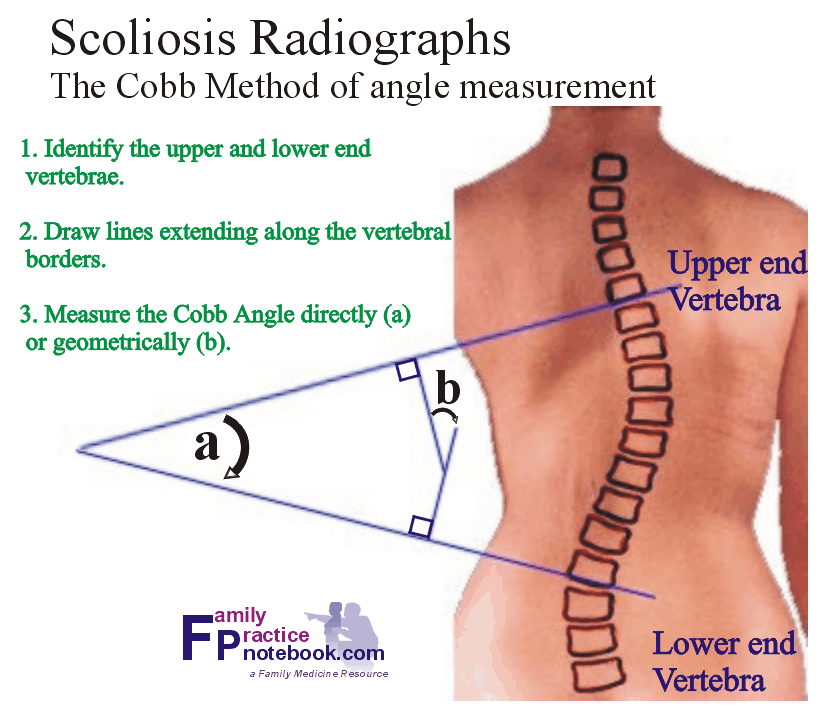
- Diagram
- Technique
- Select most tilted Vertebrae above the apex
- Draw a line along the top of the Vertebrae
- Extend the line into the margin of the Xray
- Drop a line down perpendicular to this line
- Select most tilted Vertebrae below the apex
- Draw a line along the bottom of the Vertebrae
- Extend the line into the margin of the Xray
- Raise a line up perpendicular to this line
- Measure the Cobb Angle (congruent angle)
- Angle where the two perpendicular lines meet
- Select most tilted Vertebrae above the apex
VI. Interpretation (See Scoliosis)
- Red Flag: Left thoracic curve
- May suggest spine pathology
- Curve Interpretation
- Mild: Curve <10-15 degrees
- Moderate: Curve 20-50 degrees
- Severe: Curve >45-50 degrees
- Respiratory compromise: Curve >90 degrees
VII. References
- Greene (2001) Musculoskeletal Care, AAOS, p. 696-9
- Greiner (2002) Am Fam Physician 65(9):1817-22 [PubMed]
- Kuznia (2020) Am Fam Physician 101(1):19-23 [PubMed]