
II. Epidemiology
- Most commonly active in warmer months
- Occurs throughout the United States except for Alaska
III. Types: Widow Spider scientific names
- More than 30 species worldwide
- Most common in United States
- Latrodectus mactans (Southern Black Widow)
- South Eastern U.S.
- Latrodectus hesperus (Western Black Widow)
- South Western U.S. (Arizona, New Mexico, Texas, Oklahoma, Kansas, Nevada, Utah, Southern California)
- Also found in Mexico
- Latrodectus variolus (Northern Black Widow)
- Northern U.S. (New England states) and southeastern canada
- Latrodectus mactans (Southern Black Widow)
- Less common in United States
- Latrodectus bishopi
- Latrodectus geometricus (Introduced brown Widow Spider)
- Southern United States
- Yellow-orange hour glass and milder venom
IV. Background: Lactrodectus mactans (Southeastern black widow)
- Female (only female delivers venomous bite)
- Male
- Grey coloration
- Stripes or spots
- Rarely transmit significant venom with bite
- Leg span: 1.6 to 2.0 cm (Half the female size)
-
Spiderlings
- Orange, brown and white striped pattern (zebra-like)
- Change color with molting
- Web
- Irregular, chaotic-patterned heavy, strong web
- Adult female Spider rarely leaves web
- Images
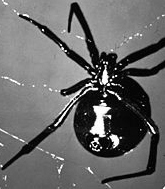
V. Background: Habitat
- Quiet, dark areas of structures (e.g. dark undisturbed corners) or rock crevices
- Indoors (Buildings)
- Dark garages
- Basements
- Stables
- Outdoors
- Yard debris
- Rock crevices
- Wood piles
- Overhangs
- Abandoned rodent holes
VI. Pathophysiology
- Highly venomous Neurotoxin: a-Latrotoxin
- Toxin binds irreversibly to presynaptic Neuron receptors
- Stimulates large presynaptic Acetylcholine release
- Bite results in systemic toxicity (Latrodectism)
- Muscle spasms and myalgias
- Excessive adrenergic stimulation
- Excessive Cholinergic stimulation
VII. Symptoms
- Initial
- Bite felt as pinprick with minimal initial pain
- First 10 to 20 minutes
- Significant pain and throbbing develops at bite site
- Most bites are limited to local reaction (without Latrodectism)
- Next 2 to 3 hours: Latrodectism (Systemic Reaction with Acetylcholine Release)
- Symptoms start at the region of the bite and progress proximally
- Symptoms recurr in waves for up to 48 to 72 hours
- Constitutional (more severe cases)
- Generalized sweating
- Musculoskeletal symptoms
- Diffuse, progressive myalgias in 100% of patients
- Cardiopulmonary symptoms (associated with upper extremity bites)
- Crampy Chest Pain or chest tightness
- Dyspnea
- Gastrointestinal Symptoms (associated with lower extremity bites)
- Facial Symptoms
- Flushed sweating face
- Contorted, Painful grimace
- Conjunctivitis
- Trismus of masseter Muscles
- Blepharitis
- Facial Edema
- Neurologic Symptoms
- Headache (27%)
- Anxiety
- Restlessness
- Paresthesias
- Seizures
- Weakness
- Tremors
VIII. Signs
- Bite wound
- Two small central red fang marks on blanched skin
- Surrounded by erythematous rings (target appearance)
- Bite may also appear as wheal and flare pattern
- Localized diaphoresis
- Muscle Fasciculations in the involved extremity
- Systemic (more severe cases)
- Fever
- Hypertension
- Diaphoresis
- Tachycardia
- Shock
- Abdominal Pain (with rigid Abdomen)
- Back pain
IX. Grading
- Grade 1
- Asymptomatic other than localized pain at Envenomation site
- Normal Vital Signs
- Grade 2
- Muscle pain in extremity with Envenomation
- Pain radiation into chest (arm bites) or Abdomen (leg bites)
- Local extremity diaphoresis
- Normal Vital Signs
- Grade 3
- Generalized Muscle pain in back, Abdomen and chest
- Generalized diaphoresis
- Abnormal Vital Signs (e.g. Hypertension, Tachycardia)
- Headache
- Nausea and Vomiting
- References
X. Differential Diagnosis
- Toxin Ingestion
- Angina
- Pneumonia
- Asthma
- Acute Abdomen (Peritonitis)
- Nephrolithiasis
XI. Course
- Symptoms resolve over 2-3 days
- Mortality approaches 1%
- Shock or death are more common in children and elderly
XII. Labs: Used to differentiate from other conditions
-
Complete Blood Count
- Distinguish from peritonitis
-
Urinalysis
- Distinguish from Urinary Tract Infection
- Serum Creatine Phosphokinase or Lactate Dehydrogenase
- Distinguish from Rhabdomyolysis
XIII. Management: General
-
General
- Cold compresses or ice pack (prevents toxin spread)
- Thorough Wound Cleansing with soap and water
- Corticosteroid ointment
- Tetanus Prophylaxis as needed
- Oral Analgesics (NSAIDs, Acetaminophen)
-
Muscle spasms, rigidity, pain
- Consider in Grade 2 (oral agents) and Grade 3 (Parenteral agents) reactions
- First-line therapy: Benzodiazepines
- Older regimens that have fallen out of favor
- Magnesium infusion
- Not effective in studies
- Calcium Gluconate
- Not effective in studies
- Adult dose: 10 ml of 10% solution) slow IV infuse
- Can be repeated every 4 hours
- Methocarbamol (Robaxin)
- Adult dose: 10-30 ml slow IV infuse
- Calcium is more effective
- Magnesium infusion
-
Opioid Analgesics
- Consider in Grade 2 (oral agents) and Grade 3 (Parenteral agents) reactions
- Monitor for respiratory depression (especially in younger patients)
- Severe Hypertension
- Disposition
- Observe for 6 hours
- May discharge home if no concerning symptoms or signs
- Consider hospital observation for Grade 3 reactions, children, and those with cardiovascular disease
XIV. Management: Antivenin (horse serum)
- Indications (rarely indicated, <4% of confirmed cases)
- Critical Envenomation (Grade 3 bites)
- Respiratory arrest
- Seizures
- Hypertensive heart disease
- Young Children or elderly
- Pregnant women
- Dosing
- Skin test first before dosing
- Evaluate for sensitivity to horse serum (5% risk of reaction)
- IV: 2.5 ml (1 vial) in 100 to 250 ml NS IV over 2 hours
- Skin test first before dosing
- Adverse effects: Serum Sickness
- Risk may be greater than risk of death by Spider Bite
- Efficacy
- Relieves symptoms within 1-2 hours
- Efficacious up to 90 hours after bite
XV. Complications
- Life threatening reactions are rare
- Pulmonary Edema
- Cardiomyopathy
- Rhabdomyolysis
- Acute Kidney Injury
- Cardiovascular Collapse
XVI. Precautions
- Hospitalize severe cases or significant comorbidity
- Cohorts to consider hospitalization
- Pregnancy
- Extremes of age (very young or old)
- Coronary Artery Disease
- Severe Hypertension
XVII. References
- Cowling and Ferreri (2019) Crit Dec Emerg Med 33(2): 17-25
- Cowling and Lowes (2024) Crit Dec Emerg Med 38(1): 4-13
- Diaz (2007) Am Fam Physician 75(6):869-73 [PubMed]
- Herness (2022) Am Fam Physician 106(2): 137-47 [PubMed]
- Ibister (2011) Lancet 378(9808): 2039-47 [PubMed]
- Juckett (2013) Am Fam Physician 88(12): 841-7 [PubMed]
- Koh (1998) Postgrad Med 103(4): 235-50 [PubMed]